


Page 44 - (DK Eyewitness) Travel Guide - Hungary
P. 44
42 INTRODUCING HUNGAR Y THE HIST OR Y OF HUNGAR Y 43
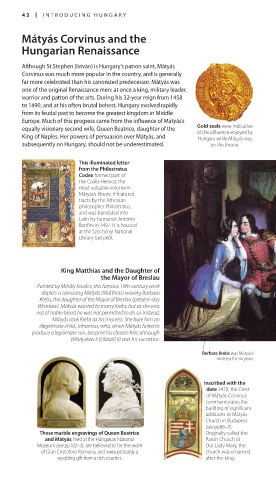
Mátyás Corvinus and the Renaissance Hungary
Hungarian Renaissance Manuscripts from The full bloom of the Renaissance
Mátyás’s library are on period took place in Hungary in the
Although St Stephen (István) is Hungary’s patron saint, Mátyás display at the Széchényi late 15th and early 16th centuries,
Corvinus was much more popular in the country, and is generally Library (see p60). Mátyás set having reached the country via a
up the first national library,
procession of Italian master craftsmen
far more celebrated than his canonized predecessor. Mátyás was Bibliotheca Corviniana, and and masons brought by Mátyás’s
one of the original Renaissance men: at once a king, military leader, sanctioned the first second wife, Queen Beatrice. The
warrior and patron of the arts. During his 32-year reign from 1458 printing press in the Turkish occupation, which changed
to 1490, and at his often brutal behest, Hungary evolved rapidly country. The earliest book the course of Hungarian art and
published in Hungary
history, destroyed much evidence
from its feudal past to become the greatest kingdom in Middle (written in Latin) was the of Renaissance splendour, but
Europe. Much of this progress came from the influence of Mátyás’s Chronica Hungarorum, Sárospatak Castle (see pp232–3)
equally visionary second wife, Queen Beatrice, daughter of the Gold seals were indicative printed in Buda in 1473. is a fine example of the style.
of the affluence enjoyed by
King of Naples. Her powers of persuasion over Mátyás, and Hungary while Mátyás was
subsequently on Hungary, should not be underestimated. on the throne. Foot soldiers in
Mátyás’s army would
have carried shields
This illuminated letter like this one. It bears
from the Philostratus part of an early
Codex formed part of coat of arms of the
the Codex Heroica, the Hunyadi family, and
most valuable volume in is exhibited at the
Mátyás’s library. It featured Hungarian National
tracts by the Athenian Museum (see pp102–3).
philosopher Philostratus,
and was translated into
Latin by humanist Antonio
Bonfini in 1497. It is housed The globe, depicted alongside
at the Széchényi National mathematical instruments,
Library (see p60). books and a telescope, reinforces The fabulous architectural detail of
the idea of Mátyás as a humanist,
scientist and man of the arts. Mátyás Church in Budapest
King Matthias and the Daughter of
the Mayor of Breslau Representing a
man and woman,
Painted by Mihály Kovács, this famous 19th-century work these wine cups
depicts a carousing Mátyás (Matthias) wooing Barbara date from the 16th
Krebs, the daughter of the Mayor of Breslau (present-day century and are
Wrocław). Mátyás wanted to marry Krebs, but as she was designed to fit
not of noble blood he was not permitted to do so. Instead, together to form
Mátyás took Krebs as his mistress. She bore him an one covered Győr Cathedral (see p178) was
illegitimate child, Johannus, who, when Mátyás failed to receptacle. The destroyed by the Mongols in the
produce a legitimate son, became his chosen heir, although cups would have 13th century, and Mátyás viewed its
Władysław II (Ulászló II) was his successor. been used in reconstruction as one of his most
elaborate wedding sacred and important duties.
celebrations during
Barbara Krebs was Mátyás’s Mátyás was a generous the Renaissance.
mistress for six years. king, known for his equity
and his admiration for the
Italian Renaissance.
Inscribed with the
date 1470, the Crest
of Mátyás Corvinus
commemorates the
building of significant Carved by an unknown
additions to Mátyás sculptor in 1526, this
Church in Budapest Virgin and Child marks Siklós Castle was first constructed in
(see pp66–7). the zenith of Hungarian
These marble engravings of Queen Beatrice Originally called the Renaissance art. Today it the late medieval period (about 1190)
but is best known for its Renaissance-
and Mátyás, held at the Hungarian National Parish Church of forms part of the Andras
Museum (see pp102–3), are believed to be the work Our Lady Mary, the Bathory collection at era modifications. It hosts a summer
Renaissance Arts Festival.
of Gian Cristoforo Romano, and were probably a church was renamed the Hungarian National
wedding gift from a rich courtier. after the king. Museum (see pp102–3).
042-043_EW_Hungary.indd 42 18/09/17 3:39 pm 042-043_EW_Hungary.indd 43 18/09/17 3:39 pm

