


Page 30 - (DK Eyewitness) Travel Guide - Chicago
P. 30
28 INTRODUCING CHIC A GO
Exploring Chicago’s Architecture Queen Anne
Chicago is world famous as a center of architectural Mainly used in residential
innovation, a city where new building techniques have architecture, Queen Anne
been developed and where architects have pushed the style was highly influential
boundaries of creative expression. This reputation had its in Chicago from the mid- to
late 1800s. The name does
beginnings in the defining event of Chicago’s history – not reflect a historical
the tragic fire of 1871. With a blank slate on which to build, period but was coined by
architects rose to the challenge, transforming devastation English architect Richard Shaw.
into opportunity and reshaping the city. It was in Chicago Queen Anne homes are built
that the world’s first skyscraper was built, and here that on a human scale. A mix of
Classical, Tudor, and Colonial
Frank Lloyd Wright developed his distinctive Prairie elements lead to a hybrid look.
School of architecture. Victorian detailing, such as
curlicue cutouts on the trim,
is often prominent.
ornate door and window Crilly Court (1885) and the
Gothic Revival designs, the windows often Olsen-Hansen Row Houses
Popular in the 1830s and 1840s, grouped into arcades. One (1886) are fine examples of
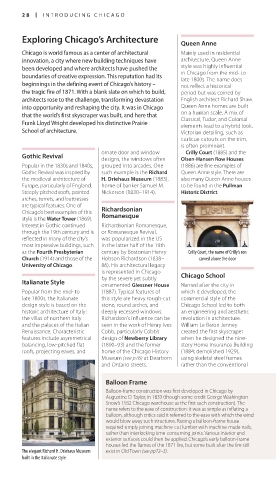
Gothic Revival was inspired by such example is the Richard Queen Anne style. There are
the medieval architecture of H. Driehaus Museum (1883), also many Queen Anne houses
Europe, parti cularly of England. home of banker Samuel M. to be found in the Pullman
Steeply pitched roofs, pointed Nickerson (1830–1914). Historic District.
arches, turrets, and buttresses
are typical features. One of Richardsonian
Chi cago’s best examples of this
style is the Water Tower (1869). Romanesque
Interest in Gothic continued Richardsonian Romanesque,
through the 19th century and is or Romanesque Revival,
reflected in many of the city’s was popularized in the US
most impressive buildings, such in the latter half of the 19th
as the Fourth Presbyterian century by Bostonian Henry Crilly Court, the name of Crilly’s son
Church (1914) and those of the Hobson Richardson (1838– carved above the door
University of Chicago. 86). His architectural legacy
is represented in Chicago Chicago School
by the severe yet subtly
Italianate Style
ornamented Glessner House Named after the city in
Popular from the mid- to (1887). Typical features of which it developed, the
late 1800s, the Italianate this style are heavy rough-cut commercial style of the
design style is based on the stone, round arches, and Chicago School led to both
historic architecture of Italy: deeply recessed windows. an engineering and aesthetic
the villas of northern Italy Richardson’s influence can be revolution in architecture.
and the palaces of the Italian seen in the work of Henry Ives William Le Baron Jenney
Renaissance. Characteristic Cobb, particularly Cobb’s created the first skyscraper
features include asymmetrical design of Newberry Library when he designed the nine-
balancing, low-pitched flat (1890–93) and the former story Home Insurance Building
roofs, projecting eaves, and home of the Chicago History (1884; demo lished 1929),
Museum (see p76) at Dearborn using skeletal steel frames
and Ontario streets. rather than the conventional
Balloon Frame
Balloon-frame construction was first developed in Chicago by
Augustine D. Taylor, in 1833 (though some credit George Washington
Snow’s 1932 Chicago warehouse as the first such construction). The
name refers to the ease of construction: it was as simple as inflating a
balloon, although critics said it referred to the ease with which the wind
would blow away such structures. Raising a balloon-frame house
required simply joining machine-cut lumber with machine-made nails,
rather than interlocking time-consuming joints. Various interior and
exterior surfaces could then be applied. Chicago’s early balloon-frame
houses fed the flames of the 1871 fire, but some built after the fire still
The elegant Richard H. Driehaus Museum exist in Old Town (see pp72–3).
built in the Italianate style
028-029_EW_Chicago.indd 28 13/07/16 2:59 pm
Eyewitness Travel LAYERS PRINTED:
Flashmap follow-on template “UK” LAYER
(Source v1.5)
Date 7th January 2013
Size 125mm x 217mm

