


Page 32 - (DK Eyewitness) Travel Guide - Chicago
P. 32
30 INTRODUCING CHIC A GO
Multicultural Chicago
Chicago prides itself on being one of the most ethnically
diverse cities in the US. In the 1840s, the Irish, fleeing their
country’s potato famine, arrived in droves in the young city
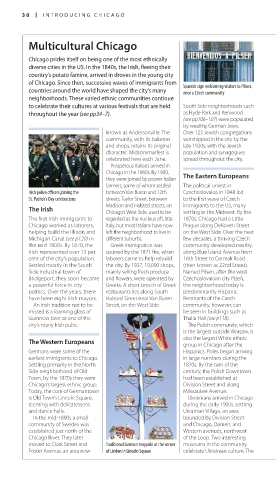
of Chicago. Since then, successive waves of immigrants from Spanish sign welcoming visitors to Pilsen,
countries around the world have shaped the city’s many once a Czech community
neighborhoods. These varied ethnic communities continue
to celebrate their cultures at various festivals that are held South Side neighborhoods such
throughout the year (see pp34–7). as Hyde Park and Kenwood
(see pp106–107) were populated
by wealthy German Jews.
known as Andersonville. The Over 125 Jewish congregations
community, with its bakeries worshipped in the city by the
and shops, retains its original late 1920s, with the Jewish
character. Midsommarfest is population and synagogues
celebrated here each June. spread throughout the city.
Prosperous Italians arrived in
Chicago in the 1860s. By 1900,
they were joined by poorer Italian The Eastern Europeans
farmers, some of whom settled The political unrest in
Irish police officers joining the between Van Buren and 12th Czechoslovakia in 1848 led
St. Patrick’s Day celebrations streets. Taylor Street, between to the first wave of Czech
Madison and Halsted streets, on immigrants to the US, many
The Irish Chicago’s West Side, used to be settling in the Midwest. By the
The first Irish immigrants to regarded as the nucleus of Little 1870s, Chicago had a Little
Chicago worked as laborers, Italy, but most Italians have now Prague along DeKoven Street
helping build the Illinois and left the neighborhood to live in on the West Side. Over the next
Michigan Canal (see p120) in different suburbs. few decades, a thriving Czech
the mid-1800s. By 1870, the Greek immigration was community developed nearby,
Irish represented over 13 per spurred by the 1871 fire, when along Blue Island Avenue from
cent of the city’s popu lation. laborers came to help rebuild 16th Street to Cermak Road
Settled mostly in the South the city. By 1927, 10,000 shops, (then known as 22nd Street).
Side industrial town of mainly selling fresh produce Named Pilsen, after the west
Bridgeport, they soon became and flowers, were operated by Czechoslovakian city Plzeň,
a powerful force in city Greeks. A short stretch of Greek the neighborhood today is
politics. Over the years, there restaurants lies along South predominantly Hispanic.
have been eight Irish mayors. Halsted Street near Van Buren Remnants of the Czech
An Irish tradition not to be Street, on the West Side. community, however, can
missed is a foaming glass of be seen in buildings such as
Guinness beer at one of the Thalia Hall (see p118).
city’s many Irish pubs. The Polish community, which
is the largest outside Warsaw, is
also the largest White ethnic
The Western Europeans group in Chicago after the
Germans were some of the Hispanics. Poles began arriving
earliest immigrants to Chicago. in large numbers during the
Settling primarily in the North 1870s. By the turn of the
Side neighborhood of Old century, the Polish Downtown
Town, by the 1870s they were had been established at
Chicago’s largest ethnic group. Division Street and along
Today, the core of Germantown Milwaukee Avenue.
is Old Town’s Lincoln Square, Ukrainians arrived in Chicago
teeming with delicatessens during the early 1900s, settling
and dance halls. Ukrainian Village, an area
In the mid-1800s a small bounded by Division Street
community of Swedes was and Chicago, Damen, and
established just north of the Western avenues, northwest
Chicago River. They later of the Loop. Two interesting
moved to Clark Street and Traditional German maypole at the corner museums in the community
Foster Avenue, an area now of Linden in Lincoln Square celebrate Ukrainian culture. The
030-031_EW_Chicago.indd 30 13/07/16 2:59 pm
Eyewitness Travel LAYERS PRINTED:
Feature template “UK” LAYER
(SourceReport v1.5)
Date 8th November 2013
Size 125mm x 217mm

