


Page 31 - (DK Eyewitness) Travel Guide - Chicago
P. 31
CHIC A GO A T A GLANCE 29
height-limiting, masonry
load-bearing walls. Prairie School Where to Find the
Jenney trained many of In the first two decades of Buildings
Chicago’s celebrated the 20th century, Frank Lloyd Charnley-Persky House pp78–9
architects, including Louis Wright developed a truly Chicago Cultural Center p54
Sullivan, William Holabird, indigenous American Crilly Court p73
Daniel Burnham, and John architectural style. Reflecting Fourth Presbyterian Church p65
Wellborn Root, whose the sweeping lines of the Glessner House p92
architect firm Midwestern landscape, Prairie IBM Building p68
designed style is characterized by low Illinois Institute of Technology p96
several horizontal lines, projecting James R. Thompson Center p58
Chicago eaves, and rectangular John Hancock Center p66
School windows. It is used mostly in Newberry Library p69
buildings, residential architecture. Oak Park pp116–17
such as the Oak Park is a treasure- Olsen-Hansen Row
Rookery trove of Wright-designed Houses p73
(1885–8) and houses. Notable Wright Pullman Historic District p121
the Reliance buildings elsewhere in Reliance Building p52
Richard H. Driehaus
Building Chicago are Robie House Museum p68
(1891–95). The (1908–1910) and Charnley- Robie House pp104–5
new window Persky House (1892). The Rookery p44
style of these Prairie School is considered Trump International Hotel &
buildings, a part of the Chicago School. Tower p79
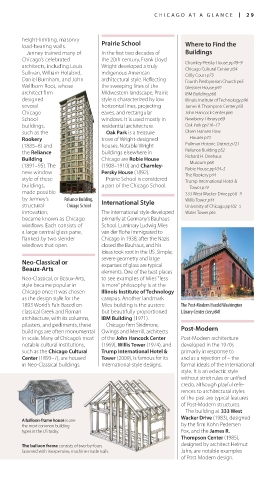
made possible 333 West Wacker Drive pp58–9
by Jenney’s Reliance Building, Willis Tower p44
structural Chicago School International Style University of Chicago pp102–5
innovation, The international style developed Water Tower p65
became known as Chicago primarily at Germany’s Bauhaus
windows. Each consists of School. Luminary Ludwig Mies
a large central glass pane, van der Rohe immigrated to
flanked by two slender Chicago in 1938, after the Nazis
windows that open. closed the Bauhaus, and his
ideas took root in the US. Simple,
severe geometry and large
Neo-Classical or expanses of glass are typical
Beaux-Arts
elements. One of the best places
Neo-Classical, or Beaux-Arts, to see examples of Mies’ “less
style became popular in is more” philosophy is at the
Chicago once it was chosen Illinois Institute of Technology
as the design style for the campus. Another landmark
1893 World’s Fair. Based on Mies building is the austere The Post-Modern Harold Washing ton
classical Greek and Roman but beautifully proportioned Library Center (see p84)
architecture, with its columns, IBM Building (1971).
pilasters, and pediments, these Chicago firm Skidmore, Post-Modern
buildings are often monumental Owings and Merrill, architects
in scale. Many of Chicago’s most of the John Hancock Center Post-Modern architecture
notable cul tural institutions, (1969), Willis Tower (1974), and developed in the 1970s
such as the Chicago Cultural Trump International Hotel & primarily in response to –
Center (1893–7), are housed Tower (2009), is famous for its and as a rejection of – the
in Neo-Classical buildings. International-style designs. formal ideals of the International
style. It is an eclectic style
without strict rules or unified
credo, although playful refe-
rences to architectural styles
of the past are typical features
of Post-Modern structures.
The building at 333 West
Wacker Drive (1983), designed
A balloon-frame house is one
the most common building by the firm Kohn Pedersen
types in the US today. Fox, and the James R.
Thompson Center (1985),
The balloon frame consists of two-by-fours designed by architect Helmut
fastened with inexpensive, machine-made nails. Jahn, are notable examples
of Post-Modern design.
028-029_EW_Chicago.indd 29 13/07/16 2:59 pm

