


Page 33 - (DK Eyewitness) Travel Guide - Chicago
P. 33
CHIC A GO A T A GLANCE 31
Lithuanian community, in the middle-class Black communities,
suburban village of Lemont, such as Park Manor, as well as
also has a strong presence in somewhat racially integrated
Chicago, as does the smaller areas, such as Hyde Park. The
Latvian community, west Black Metropolis Historic District
of Lakeview. (35th Street and Indiana Avenue)
Eastern European Jews settled is commonly known as
the West Side’s Maxwell Street at Bronzeville and was created in
Halsted Street from the 1880s 1984 to commemorate the
until the 1910s. Community life vibrant Black Belt community.
focused around the Maxwell Today, African Americans
Street Market (see p161), which represent around 33 per cent of
was once the world’s largest flea Chicago’s population.
market, with stalls selling their
reasonably priced wares.
The Hispanic Americans
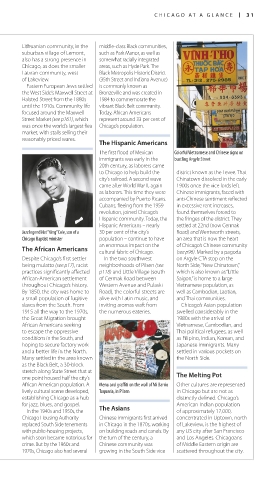
The first flood of Mexican Colorful Vietnamese and Chinese signs on
immigrants was early in the bustling Argyle Street
20th century, as laborers came
to Chicago to help build the district known as the Levee. That
city’s railroad. A second wave Chinatown dissolved in the early
came after World War II, again 1900s once the vice lords left.
as laborers. This time they were Chinese immigrants, faced with
accompanied by Puerto Ricans. anti-Chinese sentiment reflected
Cubans, fleeing from the 1959 in excessive rent increases,
revolution, joined Chicago’s found themselves forced to
Hispanic community. Today, the the fringes of the district. They
Hispanic Americans – nearly settled at 22nd (now Cermak
Jazz legend Nat “King” Cole, son of a 30 per cent of the city’s Road) and Wentworth streets,
Chicago Baptist minister population – continue to have an area that is now the heart
an enormous impact on the of Chicago’s Chinese community
The African Americans cultural fabric of Chicago. (see p96). Marked by a pagoda
Despite Chicago’s first settler In the two southwest on Argyle CTA stop on the
being mulatto (see p17), racist neighborhoods of Pilsen (see North Side, “New Chinatown,”
practices significantly affected p118) and Little Village (south which is also known as “Little
African-American settlement of Cermak Road between Saigon,” is home to a large
throughout Chicago’s history. Western Avenue and Pulaski Vietnamese population, as
By 1850, the city was home to Road), the colorful streets are well as Cambodian, Laotian,
a small population of fugitive alive with Latin music, and and Thai communities.
slaves from the South. From inviting aromas waft from Chicago’s Asian population
1915 all the way to the 1970s, the numerous eateries. swelled considerably in the
the Great Migration brought 1980s with the arrival of
African Americans seeking Vietnamese, Cambodian, and
to escape the oppressive Thai political refugees, as well
conditions in the South, and as Filipino, Indian, Korean, and
hoping to secure factory work Japanese immigrants. Many
and a better life in the North. settled in various pockets on
Many settled in the area known the North Side.
as the Black Belt, a 30-block
stretch along State Street that at
one point housed half the city’s The Melting Pot
African American population. A Menu and graffiti on the wall of Mi Barrio Other cultures are represented
lively cultural scene developed, Taqueria, in Pilsen in Chicago but are not as
establishing Chicago as a hub distinctly defined. Chicago’s
for jazz, blues, and gospel. The Asians American Indian population
In the 1940s and 1950s, the of approximately 17,000,
Chicago Housing Authority Chinese immigrants first arrived concentrated in Uptown, north
replaced South Side tenements in Chicago in the 1870s, working of Lakeview, is the highest of
with public-housing projects, on building roads and canals. By any US city after San Francisco
which soon became notorious for the turn of the century, a and Los Angeles. Chicagoans
crime. But by the 1960s and Chinese community was of Middle Eastern origin are
1970s, Chicago also had several growing in the South Side vice scattered throughout the city.
030-031_EW_Chicago.indd 31 13/07/16 2:59 pm

