


Page 44 - All About History - Issue 53-17
P. 44
Rock ‘n’ Roll


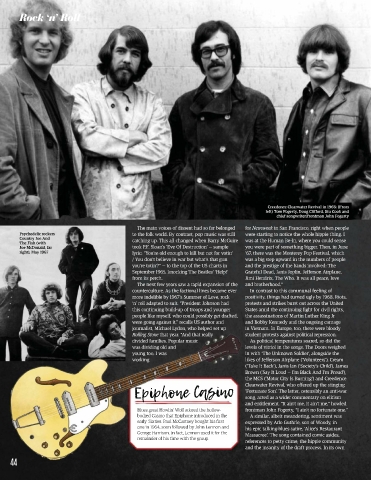
                                                                                               Creedence Clearwater Revival in 1968: (From
                                                                                              left) Tom Fogerty, Doug Clifford, Stu Cook and
                                                                                                  chief songwriter/frontman John Fogerty

                                                 The main voices of dissent had so far belonged   for Newsweek in San Francisco, right when people
        Psychedelic rockers                     to the folk world. By contrast, pop music was still   were starting to notice the whole hippie thing. I
        Country Joe And
        The Fish (with                          catching up. This all changed when Barry McGuire   was at the Human Be-In, where you could sense
        Joe McDonald, far                       took P.F. Sloan’s ‘Eve Of Destruction’ — sample   you were part of something bigger. Then, in June
        right), May 1967                        lyric: “You’re old enough to kill but not for votin’   ‘67, there was the Monterey Pop Festival, which
                                                / You don’t believe in war but what’s that gun   was a big step upward in the numbers of people
                                                you’re totin’?” — to the top of the US charts in   and the prestige of the bands involved: The
                                                September 1965, knocking The Beatles’ ‘Help!’    Grateful Dead, Janis Joplin, Jefferson Airplane,
                                                from its perch.                        Jimi Hendrix, The Who. It was all peace, love
                                                 The next few years saw a rapid expansion of the   and brotherhood.”
                                                counterculture. As the factional lines became ever   In contrast to this communal feeling of
                                                more indelible by 1967’s Summer of Love, rock   positivity, things had turned ugly by 1968. Riots,
                                                ‘n’ roll adapted to suit. “President Johnson had   protests and strikes burst out across the United
                                                this continuing build-up of troops and younger   States amid the continuing fight for civil rights,
                                                people like myself, who could possibly get drafted,   the assassinations of Martin Luther King Jr
                                                were going against it,” recalls US author and   and Bobby Kennedy and the ongoing carnage
                                                journalist, Michael Lydon, who helped set up   in Vietnam. In Europe, too, there were bloody
                                                Rolling Stone that year. “And that really   student protests against political repression.
                                                divided families. Popular music          As political temperatures soared, so did the
                                                was dividing old and                   levels of vitriol in the songs. The Doors weighed
                                                young too. I was                       in with ‘The Unknown Soldier’, alongside the
                                                working                                likes of Jefferson Airplane (‘Volunteers’), Cream
                                                                                       (‘Take It Back’), Janis Ian (‘Society’s Child’), James
                                                                                       Brown (‘Say It Loud — I’m Black And I’m Proud’),
                                                                                       the MC5 (‘Motor City Is Burning’) and Creedence
                                                Epiphone Casino                        Clearwater Revival, who offered up the stinging
                                                                                       ‘Fortunate Son’. The latter, ostensibly an anti-war
                                                                                       song, acted as a wider commentary on elitism
                                                                                       and entitlement. “It ain’t me, it ain’t me,” howled
                                                 Blues great Howlin’ Wolf adored the hollow-  frontman John Fogerty, “I ain’t no fortunate one.”
                                                 bodied Casino that Epiphone introduced in the   A similar, albeit meandering, sentiment was
                                                 early ‘Sixties. Paul McCartney bought his first   expressed by Arlo Guthrie, son of Woody, in
                                                 one in 1964, soon followed by John Lennon and   his epic talking-blues satire, ‘Alice’s Restaurant
                                                 George Harrison. In fact, Lennon used it for the   Massacree’. The song contained comic asides,
                                                 remainder of his time with the group.
                                                                                       references to petty crime, the hippie community
                                                                                       and the insanity of the draft process. In its own
     44

