


Page 42 - All About History - Issue 53-17
P. 42
Rock ‘n’ Roll


          But the rise of the Civil Rights Movement,
        allied to matters surrounding voter registration
        rights, social equality, the nuclear arms race and
        the onset of the Vietnam War, resulted in an
        outpouring of protest in 1960s America that
        was unprecedented.
          The decade was barely a month old before
        the ruptures began. In February 1960, inspired
        by Martin Luther King Jr’s policy of non-violent
        protest, four black college students staged a sit-in
        at a segregated lunch counter in Greensboro, North
        Carolina. Word spread fast, fanned by local news
        reports, and by the fourth day, there were 300
        people. Students across the state organised similar
        protests, soon followed by other Southern cities in
        Tennessee, Mississippi and Virginia.
          As the Civil Rights Movement gathered
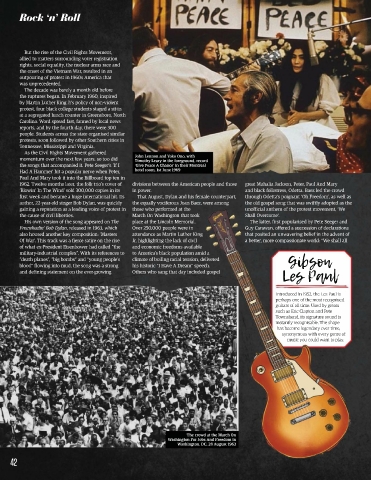
                                                John Lennon and Yoko Ono, with
        momentum over the next few years, so too did   Timothy Leary in the foreground, record
        the songs that accompanied it. Pete Seeger’s ‘If I   ‘Give Peace A Chance’ in their Montreal
        Had A Hammer’ hit a popular nerve when Peter,   hotel room, 1st June 1969
        Paul And Mary took it into the Billboard top ten in
        1962. Twelve months later, the folk trio’s cover of   divisions between the American people and those   great Mahalia Jackson, Peter, Paul And Mary
        ‘Blowin’ In The Wind’ sold 300,000 copies in its   in power.                   and black folkstress, Odetta. Baez led the crowd
        first week and became a huge international hit. Its   That August, Dylan and his female counterpart,   through Odetta’s poignant ‘Oh Freedom’, as well as
        author, 22-year-old singer Bob Dylan, was quickly   the equally vociferous Joan Baez, were among   the old gospel song that was swiftly adopted as the
        gaining a reputation as a leading voice of protest in   those who performed at the   unofficial anthem of the protest movement, ‘We
        the cause of civil liberties.           March On Washington that took          Shall Overcome’.
          His own version of the song appeared on The   place at the Lincoln Memorial.   The latter, first popularised by Pete Seeger and
        Freewheelin’ Bob Dylan, released in 1963, which   Over 250,000 people were in   Guy Carawan, offered a succession of declarations
        also housed another key composition: ‘Masters   attendance as Martin Luther King   that posited an unwavering belief in the advent of
        Of War’. This track was a fierce satire on the rise   Jr, highlighting the lack of civil   a better, more compassionate world: “We shall all
        of what ex-President Eisenhower had called “the   and economic freedoms available
        military-industrial complex”. With its references to   to America’s black population amid a
        “death planes”, “big bombs” and “young people’s   climate of boiling racial tension, delivered   Gibson
        blood” flowing into mud, the song was a strong   his historic “I Have A Dream” speech.
                                                                                                    Les Paul
        and defining statement on the ever-growing   Others who sang that day included gospel


                                                                                                  Introduced in 1952, the Les Paul is
                                                                                                  perhaps one of the most recognised
                                                                                                  guitars of all time. Used by greats
                                                                                                  such as Eric Clapton and Pete
                                                                                                  Townshend, its signature sound is
                                                                                                  instantly recognisable. The shape
                                                                                                  has become legendary over time,
                                                                                                    synonymous with every genre of
                                                                                                      music you could want to play.


                                                                   The crowd at the March On
                                                            Washington For Jobs And Freedom in
                                                               Washington, DC, 28 August 1963

     42

