


Page 43 - All About History - Issue 53-17
P. 43
Rock ‘n’ Roll


        be free, some day.” More than just a song, it was a   the top of the political agenda. A skirmish in the
        rallying cry around which all disaffected citizens   Gulf of Tonkin, just off the coast of Vietnam, had   Fender
        could unite. Within a year, JFK’s Presidential   led to the United States stepping up its operations
        successor, Lyndon Johnson, would pass the Civil   in the country from a mere military presence to   Stratocaster
        Rights Act. The bill outlawed all discrimination   open war. By early the following year, there were
        — be it racial, religious or gender-based — and   16,500 American troops deployed in the country,
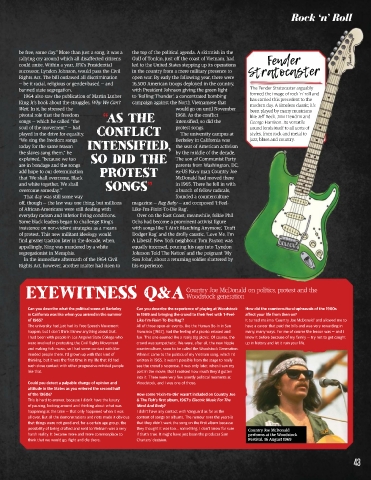
        banned state segregation.              with President Johnson giving the green light   The Fender Stratocaster arguably
         1964 also saw the publication of Martin Luther   to ‘Rolling Thunder’, a concentrated bombing   formed the image of rock ‘n’ roll and
                                                                                         has carried this precedent to the
        King Jr’s book about the struggles, Why We Can’t   campaign against the North Vietnamese that   modern day. A timeless classic, it’s
        Wait. In it, he stressed the                           would go on until November   been played by many musicians
        pivotal role that the freedom   “AS THE                1968. As the conflict     like Jeff Beck, Jimi Hendrix and
        songs — which he called “the                           intensified, so did the    George Harrison. Its versatile
        played in the drive for equality.  CONFLICT            protest songs.            sound lends itself to all sorts of
        soul of the movement” — had
                                                                The university campus at
                                                                                         styles, from rock and metal to
        “We sing the freedom songs   INTENSIFIED,              Berkeley in California was   jazz, blues and country.
        today for the same reason                              the seat of American activism
        the slaves sang them,” he                              by the middle of the decade.
        explained, “because we too   SO DID THE                The son of Communist Party
        are in bondage and the songs                           parents from Washington, DC,
        add hope to our determination   PROTEST                ex-US Navy man Country Joe
        that ‘We shall overcome, Black                         McDonald had moved there
        and white together, We shall   SONGS”                  in 1965. There he fell in with
        overcome someday.’”                                    a bunch of fellow radicals,
         That day was still some way                           founded a counterculture
        off, though — the law was one thing, but millions   magazine — Rag Baby — and composed ‘I-Feel-
        of African-Americans were still dealing with   Like-I’m-Fixin’-To-Die Rag’.
        everyday racism and inferior living conditions.   Over on the East Coast, meanwhile, folkie Phil
        Some black leaders began to challenge King’s   Ochs had become a prominent activist figure
        insistence on non-violent strategies as a means   with songs like ‘I Ain’t Marching Anymore’, ‘Draft
        of protest. This new militant ideology would   Dodger Rag’ and the drolly caustic, ‘Love Me, I’m
        find greater traction later in the decade, when,   A Liberal’. New York neighbour Tom Paxton was
        appallingly, King was murdered by a white   equally incensed, pouring his rage into ‘Lyndon
        segregationist in Memphis.             Johnson Told The Nation’ and the poignant ‘My
         In the immediate aftermath of the 1964 Civil   Son John’, about a returning soldier shattered by
        Rights Act, however, another matter had risen to   his experience.


                                                                   Country Joe McDonald on politics, protest and the
          EYEWITNESS Q&A Woodstock generation

           Can you describe what the political scene at Berkeley    Can you describe the experience of playing at Woodstock   How did the countercultural upheavals of the 1960s
           in California was like when you arrived in the summer    in 1969 and bringing the crowd to their feet with ‘I-Feel-  affect your life from then on?
           of 1965?                              Like-I’m-Fixin’-To-Die Rag’?          It turned me into ‘Country Joe McDonald’ and allowed me to
           The university had just had its Free Speech Movement   All of those open-air events, like the Human Be-In in San   have a career that paid the bills and was very rewarding in
           happen, but I don’t think I knew anything about that.    Francisco [1967], had the feeling of a picnic: relaxed and   many, many ways. For me of course the lesson was — and I
           I had been with people in Los Angeles State College who   fun. This one seemed like a really big picnic. Of course, the   knew it before because of my family — try not to get caught
           were involved in protesting the Civil Rights Movement    crowd was sympathetic. We were, after all, the new hippie   up in history and let it ruin your life.
           and making folk music, so I had some contact with like-  counterculture, soon to be called the Woodstock Generation.
           minded people there. I’d grown up with that kind of   When it came to the politics of my Vietnam song, which I’d
           thinking, but it was the first time in my life that I’d had    written in 1965, it wasn’t possible from the stage to really
           such close contact with other progressive-minded people   see the crowd’s response. It was only later, when I saw my
           like that.                            part in the movie, that I realised how much they’d gotten
                                                 into it. There were very few overtly political moments at
           Could you detect a palpable change of opinion and   Woodstock, and I was one of those.
           attitude in the States as you entered the second half
           of the 1960s?                         How come ‘Fixin-To-Die’ wasn’t included on Country Joe
           This is hard to answer, because I didn’t have the luxury   & The Fish’s first album, 1967’s Electric Music For The
           of pausing, looking around and thinking about what was   Mind And Body?
           happening at the time — that only happened when it was    I didn’t have any contact with Vanguard as far as the
           all over. But all the demonstrations and riots made it obvious   content of songs on albums. The rumour over the years is
           that things were not good and, for a certain age group, the   that they didn’t want the song on the first album because
           possibility of being drafted and sent to Vietnam was a very   they thought it was too… something. I don’t know for sure   Country Joe McDonald
           harsh reality. It became more and more commonplace to   if that’s true. It might have just been the producer Sam   performs at the Woodstock
           think that we would go, fight and die there.   Charters’ decision.           Festival, 16 August 1969


                                                                                                                             43

