


Page 40 - All About History - Issue 53-17
P. 40
Rock ‘n’ Roll


       Born to be Wild


        THE ROCK REVOLUTION


               The 1960s was a seismic decade of political

                  and social upheaval, with a soundtrack
                       that echoed the changing times


                                      Written by Rob Hughes
        T           he crowning moment of Country   lunch counters of North Carolina and peaked in


                                               600 acres of farmland in upstate New York. A
                    Joe McDonald’s career wasn’t
                                               period of accelerated change that had brought
                    exactly planned. Standing before
                    nearly half a million people at
                                               with it racial tensions, riots, student revolts and
                    Woodstock in the early afternoon
                    of 16 August 1969, he’d already   assassinations. All of this came with an apposite
                                               soundtrack, a rush of insurgent music — from folk
        played to a largely underwhelming response. A   to rock ‘n’ roll to psychedelia — that reflected the
        quick word with his tour manager had resulted   seismic changes of the times. Moreover, in its
        in him returning to the stage for one final tune,   emergence as a weapon of cultural revolution, it
        before the arrival of the next act, Santana.  sought to shape them.
         McDonald began strumming the chords to   Protest music was hardly a new concept in the
        ‘I-Feel-Like-I’m-Fixin’-To-Die Rag’, the political   1960s. Against a backdrop of the nuclear threat,
        anthem he’d recorded   “ALL OF THIS                        McCarthyism, the Cold
        with his band, Country                                     War and the leftist
        Joe & The Fish. A bitingly                                 progressive movement,
        sarcastic critique of US   CAME WITH                       the post-war years had
        policy in Vietnam, in                                      seen a marked increase
        particular the escalating   AN APPOSITE                    in the number of songs
        numbers of young                                           that addressed social
        conscripts, the song’s   SOUNDTRACK”                       and political issues.
        power lay in both the                                      Woody Guthrie, Josh
        immediacy of its message and its singalong verses.   White, Harry Belafonte and The Weavers (featuring
        The Woodstock masses shook themselves from   the outspoken Pete Seeger) had been at the
        their slumber and began joining in: “And it’s one,   vanguard in the United States, while a small cadre
        two, three, what are we fighting for? / Don’t ask   of voices — chief among them folk singer Ewan
        me I don’t give a damn / Next stop is Vietnam /   MacColl — had aligned themselves to Campaign
        And it’s five, six, seven, open up the pearly gates /   for Nuclear Disarmament in Britain.
        Well there ain’t no time to wonder why / Whoopie!
        We’re all gonna die.”
         The crowd became more animated and rose to
        their feet — yelling, clapping and roaring approval
        — as McDonald led them to a feverish finale. By
        the time he’d exited the stage, acoustic guitar held
        aloft in salute, they were screaming for more. It’s a
        scene immortalised in Michael Wadleigh’s Oscar-
        winning Woodstock documentary, released the
        following year, and one that came to embody the
        disaffection and rage that pumped the heart of the
        American counterculture.
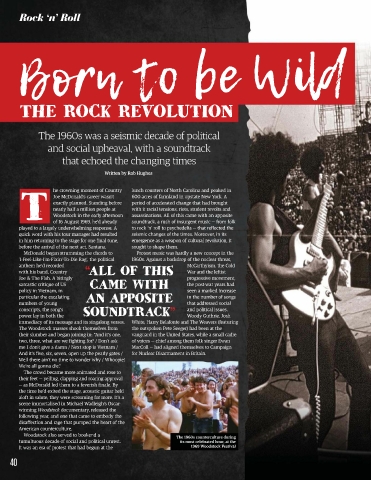
         Woodstock also served to bookend a                    The 1960s counterculture during
        tumultuous decade of social and political unrest.       its most celebrated hour, at the
        It was an era of protest that had begun at the              1969 Woodstock Festival
     40

