


Page 39 - All About History - Issue 53-17
P. 39
Through History


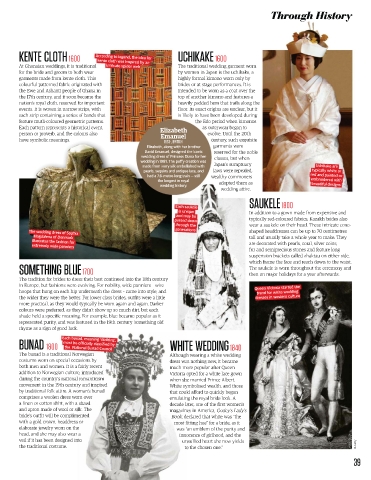
        KENTE CLOTH 1600          .According to legend, the idea for   UCHIKAKE 1600
                                   .kente cloth was inspired by an
        At Ghanaian weddings, it is traditional   .intricate spider web  The traditional wedding garment worn
        for the bride and groom to both wear                    by women in Japan is the uchikake, a
        garments made from kente cloth. This                    highly formal kimono worn only by
        colourful patterned fabric originated with              brides or at stage performances. It is
        the Ewe and Ashanti people of Ghana in                  intended to be worn as a coat over the
        the 17th century, and it soon became the                top of another kimono and features a
        nation’s royal cloth, reserved for important            heavily padded hem that trails along the
        events. It is woven in narrow strips, with              floor. Its exact origins are unclear, but it
        each strip containing a series of bands that            is likely to have been developed during
        feature mutli-coloured geometric patterns.                    the Edo period when kimonos
        Each pattern represents a historical event,      Elizabeth      as outerwear began to
        person or proverb, and the colours also          Emanuel          evolve. Until the 20th
        have symbolic meanings.                            1953-, BRITISH  century, such exquisite
                                                     Elizabeth, along with her brother   garments were
                                                    David Emanuel, designed the iconic   reserved for the noble
                                                   wedding dress of Princess Diana for her   classes, but when
                                                  wedding in 1981. The puffy creation was
                                                   made from ivory silk embellished with   Japan’s sumptuary    .Uchikake are
                                                    pearls, sequins and antique lace, and   laws were repealed,   .typically white or
                                                     had a 7.6-metre-long train — still   wealthy commoners   .red and painted or
                                                        the longest in royal    adopted them as               .embroidered with
                                                         wedding history.                                     .beautiful designs
                                                                               wedding attire.

                                                                                         SAUKELE 1800
                                                              .Each saukele
                                                               .is unique                In addition to a gown made from expensive and
                                                               .and may be
                                                                                         typically red-coloured fabrics, Kazakh brides also
                                                              .passed down
                                                              .through the               wear a saukele on their head. These intricate cone-
                                                              .generations
           The wedding dress of Sophia                                                   shaped headdresses can be up to 70 centimetres
                                                                                         tall and usually take a whole year to make. They
             Magdalena of Denmark
            illustrates the fashion for
                                                                                         are decorated with pearls, coral, silver coins,
            extremely wide panniers
                                                                                         fur and semiprecious stones and feature long
                                                                                         suspension brackets called zhaktau on either side,
                                                                                         which frame the face and reach down to the waist.
                                                                                         The saukele is worn throughout the ceremony and
        SOMETHING BLUE 1700                                                              then on major holidays for a year afterwards.
        The tradition for brides to dress their best continued into the 18th century
        in Europe, but fashions were evolving. For nobility, wide panniers – wire          Queen Victoria started the
        hoops that hung on each hip underneath the dress – came into style, and            trend for white wedding
        the wider they were the better. For lower class brides, outfits were a little      dresses in western culture
        more practical, as they would typically be worn again and again. Darker
        colours were preferred, as they didn’t show up so much dirt, but each
        shade held a specific meaning. For example, blue became popular as it
        represented purity, and was featured in the 19th century ‘something old’
        rhyme as a sign of good luck.
                       .Each bunad, meaning ‘clothing’,
        BUNAD 1800     .must be officially classified by          TE WEDDING 1840
                       .the .National Bunad Council.
                            o
                               g
        The bunad is a traditional Norwegian                 Al hhough h wearing a white wedding
                                                             Al
                                                              t
        costume worn on special occ casions by               d dress wa as nothing new, it became
                                  y
        both men and women. It is a fairly recent            m much m
                                                                 more popular after Queen
        addition to Norwegian culture e, introduced          V Victoria o opted for a white lace gown
        during the country’s national l romanticism          when sh he married Prince Albert.
                                                             wh
                                   p
        movement in the 19th century ry and inspired         Wh   ymbolised wealth, and those
                                                             White sy
        by traditional folk attire. A wo oman’s bunad        t that coul ld afford to quickly began
        comprises a woolen dress wo orn over                 e emulatin
                                                                  ng the royal bride look. A
                                                                l
        a linen or cotton shirt, with a  h shawl  l          d decade la ater, one of the first women’s
        and apron made of wool or si ilk. The                magazin
                                                             m g ines in America, Godey’s Lady’s
        bride’s outfit will be complim mented                B Book, d
                                                                k
                                                                k   eclared that white was “the
        with a gold crown, headdress s or                     most f fitting hue” for a bride, as it
        elaborate jewelry worn on the   e                      w was “ “an emblem of the purity and
        head, and she may also wear    a                        i inno
                                                                  ocence of girlhood, and the
        veil if it has been designed in nto                      un
                                                                  nsullied heart she now yields
        the traditional costume.                                  to o the chosen one.”                                       © Alamy
                                                                                                                             39

