


Page 61 - All About History - Issue 53-17
P. 61
BATTLE OF THE


                                                          GOLDEN SPURS


                                                        COURTRAI, COUNTY OF FLANDERS 11 JULY 1302


                                                                             Written by Mike Haskew

                                                    he territorial ambitions of King Philip IV   As the French marched across Flanders towards
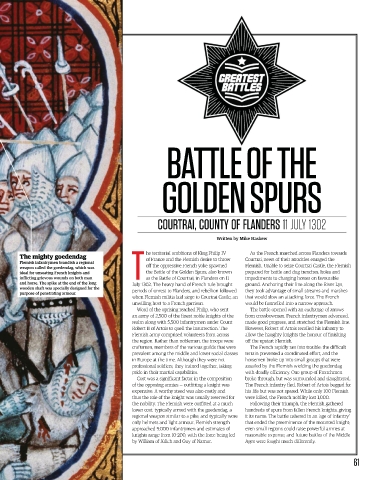
        The mighty goedendag
        Flemish infantrymen brandish a regional     of France and the Flemish desire to throw   Courtrai, news of their atrocities enraged the
        weapon called the goedendag, which was      off the oppressive French yoke spawned   Flemish. Unable to seize Courtrai Castle, the Flemish
        ideal for unseating French knights and      the Battle of the Golden Spurs, also known   prepared for battle and dug trenches, holes and
        inflicting grievous wounds on both man   T as the Battle of Courtrai, in Flanders on 11   impediments to charging horses on favourable
        and horse. The spike at the end of the long   July 1302. The heavy hand of French rule brought   ground. Anchoring their line along the River Lys,
        wooden shaft was specially designed for the
        purpose of penetrating armour.         periods of unrest to Flanders, and rebellion followed   they took advantage of small streams and marshes
                                               when Flemish militia laid siege to Courtrai Castle, an   that would slow an attacking force. The French
                                               unwilling host to a French garrison.    would be funnelled into a narrow approach.
                                                 Word of the uprising reached Philip, who sent   The battle opened with an exchange of arrows
                                               an army of 2,500 of the finest noble knights of the   from crossbowmen. French infantrymen advanced,
                                               realm along with 5,500 infantrymen under Count   made good progress, and stretched the Flemish line.
                                               Robert II of Artois to quell the insurrection. The   However, Robert of Artois recalled his infantry to
                                               Flemish army comprised volunteers from across   allow the haughty knights the honour of finishing
                                               the region. Rather than noblemen, the troops were   off the upstart Flemish.
                                               craftsmen, members of the various guilds that were   The French rapidly ran into trouble: the difficult
                                               prevalent among the middle and lower social classes   terrain prevented a coordinated effort, and the
                                               in Europe at the time. Although they were not   horsemen broke up into small groups that were
                                               professional soldiers, they trained together, taking   assailed by the Flemish wielding the goedendag
                                               pride in their martial capabilities.    with deadly efficiency. One group of Frenchmen
                                                 Cost was a significant factor in the composition   broke through, but was surrounded and slaughtered.
                                               of the opposing armies — outfitting a knight was   The French infantry fled. Robert of Artois begged for
                                               expensive. A worthy steed was also costly and   his life but was not spared. While only 100 Flemish
                                               thus the role of the knight was usually reserved for   were killed, the French nobility lost 1,000.
                                               the nobility. The Flemish were outfitted at a much   Following their triumph, the Flemish gathered
                                               lower cost, typically armed with the goedendag, a   hundreds of spurs from fallen French knights, giving
                                               regional weapon similar to a pike, and typically wore   it its name. The battle ushered in an ‘age of infantry’
                                               only helmets and light armour. Flemish strength   that ended the preeminence of the mounted knight;
                                               approached 9,000 infantrymen and estimates of   even small regions could raise powerful armies at
                                               knights range from 10-200, with the force being led   reasonable expense, and future battles of the Middle
                                               by William of Jülich and Guy of Namur.  Ages were fought much differently.


                                                                                                                             61

