


Page 17 - Shark
P. 17
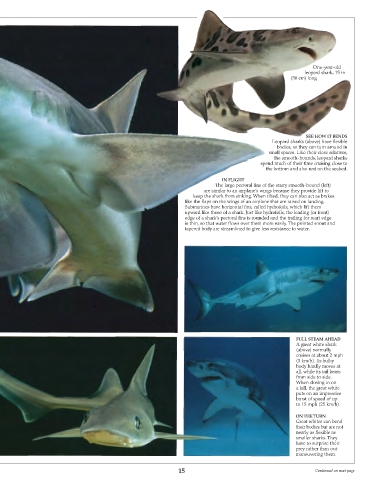
One-year-old
                                                                                                      leopard shark, 15 in
                                                                                                 (38 cm) long


                                                                                                      See how iT bendS
                                                                                           Leopard sharks (above) have flexible
                                                                                             bodies, so they can turn around in
                                                                                          small spaces. Like their close relatives,
                                                                                            the smooth-hounds, leopard sharks
                                                                                       spend much of their time cruising close to
                                                                                         the bottom and also rest on the seabed.

                                                                           in flighT
                                                                        The large pectoral fins of the starry smooth-hound (left)
                                                                     are similar to an airplane’s wings because they provide lift to
                                                                 keep the shark from sinking. When tilted, they can also act as brakes
                                                              like the flaps on the wings of an airplane that are raised on landing.
                                                              Submarines have horizontal fins, called hydrofoils, which lift them
                                                              upward like those of a shark. Just like hydrofoils, the leading (or front)
                                                              edge of a shark’s pectoral fins is rounded and the trailing (or rear) edge
                                                              is thin, so that water flows over them more easily. The pointed snout and
                                                              tapered body are streamlined to give less resistance to water.


                                                                                                   full STeam ahead
                                                                                                   A great white shark
                                                                                                   (above) normally
                                                                                                   cruises at about 2 mph
                                                                                                   (3 km/h). Its bulky
                                                                                                   body hardly moves at
                                                                                                   all, while its tail beats
                                                                                                   from side to side.
                                                                                                   When closing in on
                                                                                                   a kill, the great white
                                                                                                   puts on an impressive
                                                                                                   burst of speed of up
                                                                                                   to 15 mph (25 km/h).

                                                                                                   on The Turn
                                                                                                   Great whites can bend
                                                                                                   their bodies but are not
                                                                                                   nearly as flexible as
                                                                                                   smaller sharks. They
                                                                                                   have to surprise their
                                                                                                   prey rather than out-
                                                                                                   maneuvering them.

                                                            15                                           Continued on next page

