


Page 16 - Shark
P. 16
Amazing grace


                           Sharks are graceful swimmers
                           propelling themselves through the
                           water by beating their tails from side
                           to side. The pectoral fins are held out
                           from the body and as water flows over
                           them, lift is generated to keep the shark
                           from sinking. Further lift is produced by the
                           upper lobe of the tail, which tends to push the
                           head down, so that the shark can swim on the level.
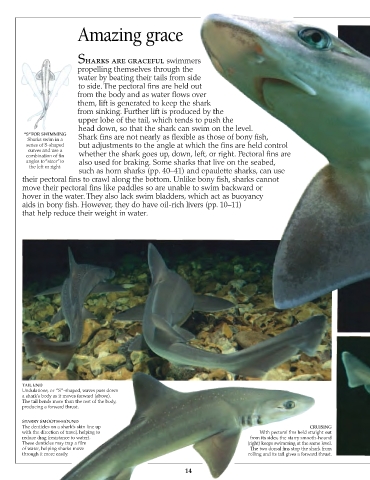
         “S” for Swimming  Shark fins are not nearly as flexible as those of bony fish,
          Sharks swim in a
          series of S-shaped   but adjustments to the angle at which the fins are held control
          curves and use a
          combination of fin   whether the shark goes up, down, left, or right. Pectoral fins are
          angles to “steer” to   also used for braking. Some sharks that live on the seabed,
           the left or right.
                           such as horn sharks (pp. 40–41) and epaulette sharks, can use
        their pectoral fins to crawl along the bottom. Unlike bony fish, sharks cannot
        move their pectoral fins like paddles so are unable to swim backward or
        hover in the water. They also lack swim bladders, which act as buoyancy
        aids in bony fish. However, they do have oil-rich livers (pp. 10–11)
        that help reduce their weight in water.


        Tail end
        Undulations, or  “S”-shaped, waves pass down
        a shark’s body as it moves forward (above).
        The tail bends more than the rest of the body,
        producing a forward thrust.

        STarry SmooTh-hound
        The denticles on a shark’s skin line up                                                         CruiSing
        with the direction of travel, helping to                                       With pectoral fins held straight out
        reduce drag (resistance to water).                                          from its sides, the starry smooth-hound
        These denticles may trap a film                                            (right) keeps swimming at the same level.
        of water, helping sharks move                                               The two dorsal fins stop the shark from
        through it more easily.                                                    rolling and its tail gives a forward thrust.

                                                              14

