


Page 30 - Shark
P. 30
The great white shark


                                                                                                                Dorsal
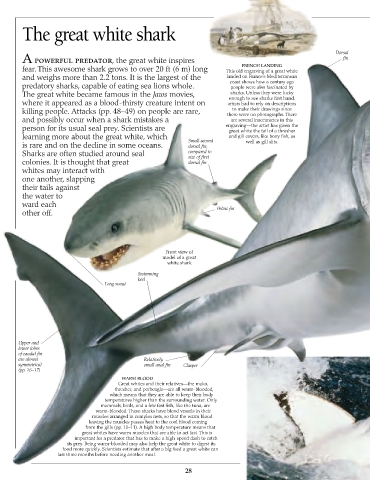
        A powerful predator, the great white inspires                                                              fin
                                                                                 French landing
        fear. This awesome shark grows to over 20 ft (6 m) long             This old engraving of a great white
        and weighs more than 2.2 tons. It is the largest of the             landed on France’s Mediterranean
        predatory sharks, capable of eating sea lions whole.                 coast shows how a century ago
                                                                             people were also fascinated by
                                                                             sharks. Unless they were lucky
        The great white became famous in the Jaws movies,                    enough to see sharks first hand,
        where it appeared as a blood-thirsty creature intent on             artists had to rely on descriptions
                                                                              to make their drawings since
        killing people. Attacks (pp. 48–49) on people are rare,             there were no photographs. There
        and possibly occur when a shark mistakes a                           are several inaccuracies in this
        person for its usual seal prey. Scientists are                      engraving—the artist has given the
                                                                             great white the tail of a thresher
        learning more about the great white, which                           and gill covers, like bony fish, as
        is rare and on the decline in some oceans.             Small second       well as gill slits.
                                                               dorsal fin,
        Sharks are often studied around seal                   compared to
                                                               size of first
        colonies. It is thought that great                     dorsal fin
        whites may interact with
        one another, slapping
        their tails against
        the water to
        ward each
        other off.                                                       Pelvic fin


                                                        Front view of
                                                       model of a great
                                                        white shark
                                               Swimming
                                               keel
                                    Long snout


       Upper and
       lower lobes
       of caudal fin
       are almost                                Relatively
       symmetrical                               small anal fin  Clasper
       (pp. 16–17)
                                         Warm blood
                                        Great whites and their relatives—the mako,
                                       thresher, and porbeagle—are all warm-blooded,
                                     which means that they are able to keep their body
                                    temperatures higher than the surrounding water. Only
                                  mammals, birds, and a few fast fish, like the tuna, are
                                 warm-blooded. These sharks have blood vessels in their
                                muscles arranged in complex nets, so that the warm blood
                               leaving the muscles passes heat to the cool blood coming
                             from the gills (pp. 10–11). A high body temperature means that
                            great whites have warm muscles that are able to act fast. This is
                          important for a predator that has to make a high-speed dash to catch
                       its prey. Being warm-blooded may also help the great white to digest its
                      food more quickly. Scientists estimate that after a big feed a great white can
                    last three months before needing another meal.

                                                              28

