


Page 26 - Shark
P. 26
Teeth and diet


                                                                         Sharks continually lose their teeth.
                                                                         When the front ones wear out they are
                                                                         replaced by new ones growing in
                                                                         another row behind them. An individual
                                                                         shark can get through thousands
                                                                         of teeth in a lifetime. Animals, like
                                                                         elephants and seals, cannot replace
                                                                         their teeth and die when they wear out.
                                                                         As the shark grows, its new teeth are
                                                                         larger than the ones they replace.
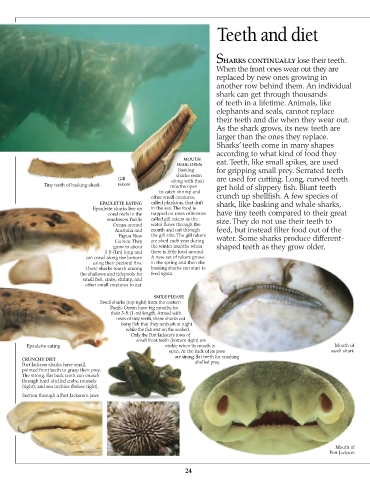
                                                                         Sharks’ teeth come in many shapes
                                                                         according to what kind of food they
                                                              Mouth      eat. Teeth, like small spikes, are used
                                                            widE opEn
                                                            Basking      for gripping small prey. Serrated teeth
                                                           sharks swim
                                        Gill              along with their   are used for cutting. Long, curved teeth
                Tiny teeth of basking shark  rakers      mouths open     get hold of slippery fish. Blunt teeth
                                                      to catch shrimp and
                                                   other small creatures,   crunch up shellfish. A few species of
                                  EpaulEttE Eating  called plankton, that drift   shark, like basking and whale sharks,
                                Epaulette sharks live on   in the sea. The food is
                                     coral reefs in the   trapped on rows of bristles   have tiny teeth compared to their great
                                    southwest Pacific   called gill rakers as the   size. They do not use their teeth to
                                      Ocean around   water flows through the
                                       Australia and   mouth and out through   feed, but instead filter food out of the
                                        Papua New   the gill slits. The gill rakers   water. Some sharks produce different-
                                       Guinea. They   are shed each year during
                                       grow to about     the winter months when   shaped teeth as they grow older.
                                    3 ft (1m) long and   there is little food around.
                             can crawl along the bottom   A new set of rakers grows
                                using their pectoral fins.   in the spring and then the
                             These sharks search among   basking sharks can start to
                            the shallows and tidepools for   feed again.
                            small fish, crabs, shrimp, and
                             other small creatures to eat.

                                                    SMilE plEaSE
                                  Swell sharks (top right) from the eastern
                                      Pacific Ocean have big mouths for
                                      their 3-ft (1-m) length. Armed with
                                        rows of tiny teeth, these sharks eat
                                         bony fish that they ambush at night
                                           while the fish rest on the seabed.
                                            Only the Port Jackson’s rows of
                                              small front teeth (bottom right) are
          Epaulette eating                              visible when its mouth is                               Mouth of
                                                         open. At the back of its jaws                         swell shark
                                                           are strong, flat teeth for crushing
        CrunChy diEt
        Port Jackson sharks have small,                           shelled prey.
        pointed front teeth to grasp their prey.
        The strong, flat back teeth can crunch
        through hard-shelled crabs, mussels
        (right), and sea urchins (below right).
        Section through a Port Jackson’s jaws


                                                                                                                Mouth of
                                                                                                              Port Jackson

                                                              24

