


Page 112 - (DK Eyewitness) Travel Guide - South Africa
P. 112
110 WILD SOUTH AFRIC A
Birds Family
With a national checklist of about 850 species, South Africa A growing body of genetic
and fossil evidence suggests
sup ports an exceptionally varied avifauna. The most that birds are most properly
prolific areas for birding are in the northeast (especially placed with crocodiles as the
the Kruger National Park, Ndumo Game Reserve and only living members of the
iSimangaliso Wetland Park), where enthusiasts may easily Archosauria, a group that also
includes the extinct dinosaurs.
see up to 100 species in a day. Avian diversity is greatest from
Septem ber to April, when migrants arrive and residents shed
their drab plumage to emerge in brilliant breeding colours.
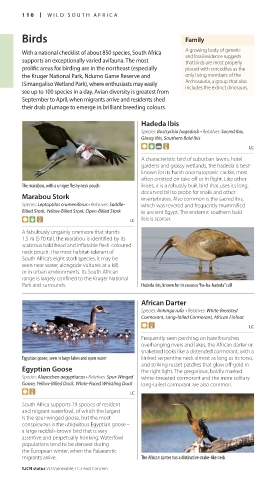
Hadeda Ibis
Species: Bostrychia hagedash • Relatives: Sacred Ibis,
Glossy Ibis, Southern Bald Ibis
LC
A characteristic bird of suburban lawns, hotel
gardens and grassy wetlands, the hadeda is best-
known for its harsh onomatopoeic cackle, most
often emitted on take off or in flight. Like other
The marabou, with a unique fleshy neck pouch ibises, it is a robustly built bird that uses its long,
decurved bill to probe for snails and other
Marabou Stork invertebrates. Also common is the sacred ibis,
Species: Leptoptilos crumeniferus • Relatives: Saddle- which was revered and fre quently mummified
Billed Stork, Yellow-Billed Stork, Open-Billed Stork in ancient Egypt. The endemic southern bald
LC ibis is scarcer.
A fabulously ungainly omnivore that stands
1.5 m (5 ft) tall, the marabou is identified by its
scabrous bald head and inflatable flesh-coloured
neck pouch. The most habitat-tolerant of
South Africa’s eight stork species, it may be
seen near water, alongside vultures at a kill,
or in urban environments. Its South African
range is largely confined to the Kruger National
Park and surrounds. Hadeda ibis, known for its raucous “ha-ha-hadeda” call
African Darter
Species: Anhinga rufa • Relatives: White-Breasted
Cormorant, Long-Tailed Cormorant, African Finfoot
LC
Frequently seen perching on bare branches
overhanging rivers and lakes, the African darter or
snakebird looks like a distended cormorant, with a
Egyptian goose, seen in large lakes and open water kinked serpentine neck almost as long as its torso,
and striking russet patches that glow off-gold in
Egyptian Goose the right light. The gregari ous, boldly marked
Species: Alopochen aegyptiacus • Relatives: Spur-Winged white-breasted cormorant and the more solitary
Goose, Yellow-Billed Duck, White-Faced Whistling Duck long-tailed cormorant are also common.
LC
South Africa supports 19 species of resident
and migrant waterfowl, of which the largest
is the spur-winged goose, but the most
conspic uous is the ubiquitous Egyptian goose –
a large reddish-brown bird that is very
assertive and perpetually honking. Waterfowl
popula tions tend to be densest during
the European winter, when the Palaearctic
migrants arrive. The African darter has a distinctive snake-like neck
IUCN status VU: Vulnerable; LC: Least Concern
110-111_EW_South_Africa.indd 110 25/05/17 2:45 pm

