


Page 116 - (DK Eyewitness) Travel Guide - South Africa
P. 116
114 WILD SOUTH AFRIC A
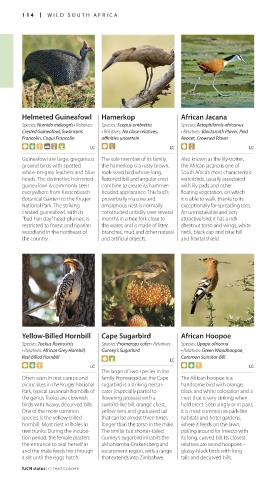
Helmeted Guineafowl Hamerkop African Jacana
Species: Numida meleagris • Relatives: Species: Scopus umbretta Species: Actophilornis africanus
Crested Guineafowl, Swainson’s • Relatives: No close relatives, • Relatives: Blacksmith Plover, Pied
Francolin, Coqui Francolin affinities uncertain Avocet, Crowned Plover
LC LC LC
Guineafowl are large, gregari ous The sole member of its family, Also known as the lily-trotter,
ground birds with spotted the hamerkop is a rusty brown, the African jacana is one of
white-on-grey feathers and blue rook-sized bird whose long, South Africa’s most charac teristic
heads. The distinctive helmeted flattened bill and angular crest waterbirds, usually associated
guineafowl is commonly seen combine to create its hammer- with lily pads and other
everywhere from Kirstenbosch headed appearance. This bird’s floating vegetation, on which
Botanical Garden to the Kruger proverbially massive and it is able to walk, thanks to its
National Park. The striking amorphous nest is normally exceptionally far-spreading toes.
crested guinea fowl, with its constructed untidily over several An unmistak able and very
“bad hair day” head-plumes, is months in a tree fork close to attractive bird, it has a rich
restricted to forest and riparian the water, and is made of litter, chestnut torso and wings, white
woodland in the northeast of branches, mud and other natural neck, black cap and blue bill
the country. and artificial objects. and frontal shield.
Yellow-Billed Hornbill Cape Sugarbird African Hoopoe
Species: Tockus flavirostris Species: Promerops cafer • Relatives: Species: Upapa africana
• Relatives: African Grey Hornbill, Gurney’s Sugarbird • Relatives: Green Woodhoopoe,
Red-Billed Hornbill LC Common Scimitar-Bill
LC LC
The larger of two species in the
Often seen in rest camps and family Promeropidae, the Cape The African hoopoe is a
picnic sites in the Kruger National sugarbird is a striking nectar- handsome bird with orange,
Park, typical savannah hornbills of eater (especially partial to black and white coloration and a
the genus Tockus are clown ish flowering proteas) with a crest that is very striking when
birds with heavy, decurved bills. sunbird-like bill, orange chest, held erect. Seen singly or in pairs,
One of the more common yellow vent and graduated tail it is most common in park-like
species is the yellow-billed that can be almost three times habitats and hotel gardens,
hornbill. Most nest in holes in longer than the torso in the male. where it feeds on the lawn,
tree trunks. During the incuba- The similar but shorter-tailed poking around for insects with
tion period, the female plasters Gurney’s sugarbird inhabits the its long, curved bill. Its closest
the entrance to seal herself in uKhahlamba-Drakensberg and relatives are wood hoopoes –
and the male feeds her through escarpment region, with a range glossy-black birds with long
a slit until the eggs hatch. that extends into Zimbabwe. tails and decurved bills.
IUCN status LC: Least Concern
114-115_EW_South_Africa.indd 114 25/05/17 2:45 pm

