


Page 117 - (DK Eyewitness) Travel Guide - South Africa
P. 117
FIELD GUIDE 115
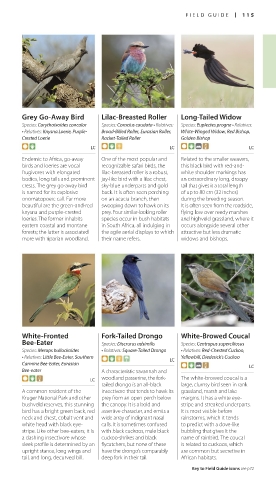
Grey Go-Away Bird Lilac-Breasted Roller Long-Tailed Widow
Species: Corythaixoides concolor Species: Coracius caudata • Relatives: Species: Euplectes progne • Relatives:
• Relatives: Knysna Loerie, Purple- Broad-Billed Roller, Eurasian Roller, White-Winged Widow, Red Bishop,
Crested Loerie Racket-Tailed Roller Golden Bishop
LC LC LC
Endemic to Africa, go-away One of the most popular and Related to the smaller weavers,
birds and loeries are vocal recognizable safari birds, the this black bird with red-and-
frugivores with elongated lilac-breasted roller is a robust, white shoulder markings has
bodies, long tails and promi nent jay-like bird with a lilac chest, an extraordinary long, droopy
crests. The grey go-away bird sky-blue underparts and gold tail that gives it a total length
is named for its explosive back. It is often seen perching of up to 80 cm (32 inches)
onomatopoeic call. Far more on an acacia branch, then during the breeding season.
beautiful are the green-and-red swooping down to hawk on its It is often seen from the roadside,
knysna and purple-crested prey. Four similar-looking roller flying low over reedy marshes
loeries. The former inhabits species occur in bush habitats and highveld grassland, where it
eastern coastal and montane in South Africa, all indulging in occurs alongside several other
forests; the latter is associated the agile aerial displays to which attractive but less dramatic
more with riparian woodland. their name refers. widows and bishops.
White-Fronted Fork-Tailed Drongo White-Browed Coucal
Bee-Eater Species: Discrurus adsimilis Species: Centropus superciliosus
Species: Merops bullockoides • Relatives: Square-Tailed Drongo • Relatives: Red-Chested Cuckoo,
• Relatives: Little Bee-Eater, Southern LC Yellowbill, Diederick’s Cuckoo
Carmine Bee-Eater, Eurasian LC
Bee-eater A characteristic savannah and
LC woodland passerine, the fork- The white-browed coucal is a
tailed drongo is an all-black large, clumsy bird seen in rank
A common resident of the insectivore that tends to hawk its grassland, marsh and lake
Kruger National Park and other prey from an open perch below mar gins. It has a white eye-
bush veld reserves, this stunning the canopy. It is a bold and stripe and streaked underparts.
bird has a bright green back, red assertive character, and emits a It is most visible before
neck and chest, cobalt vent and wide array of indignant nasal rainstorms, which it tends
white head with black eye- calls. It is sometimes confused to predict with a dove-like
stripe. Like other bee-eaters, it is with black cuckoos, male black bubbling that gives it the
a dashing insectivore whose cuckoo-shrikes and black name of rainbird. The coucal
sleek profile is determined by an flycatchers, but none of these is related to cuckoos, which
upright stance, long wings and have the drongo’s comparably are common but secret ive in
tail, and long, decurved bill. deep fork in their tail. African habitats.
Key to Field Guide icons see p72
114-115_EW_South_Africa.indd 115 25/05/17 2:45 pm

