


Page 113 - (DK Eyewitness) Travel Guide - South Africa
P. 113
FIELD GUIDE 111
Greater Flamingo
Species: Phoenicopterus roseus • Relatives: Lesser
Flamingo
LC
Represented by two species in South Africa, both
of which are associated with flat, shallow pans,
flamingoes are pink-tinged birds that feed on
algae and microscopic fauna, which are sifted
through filters in their unique down-turned bills.
They are very sensitive to water levels and
chemical composition, and will easily relocate.
The greater flamingo is the lar ger of the two
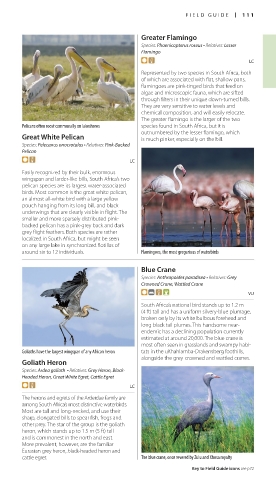
Pelicans often roost communally on lakeshores species found in South Africa, but it is
outnumbered by the lesser flamingo, which
Great White Pelican is much pinker, especially on the bill.
Species: Pelecanus onocrotalus • Relatives: Pink-Backed
Pelican
LC
Easily recognized by their bulk, enormous
wingspan and larder-like bills, South Africa’s two
pelican species are its largest water-associated
birds. Most common is the great white pelican,
an almost all-white bird with a large yellow
pouch hanging from its long bill, and black
underwings that are clearly visible in flight. The
smaller and more sparsely distributed pink-
backed pelican has a pink-grey back and dark
grey flight feathers. Both species are rather
localized in South Africa, but might be seen
on any large lake in synchro nized flotillas of
around six to 12 individuals. Flamingoes, the most gregarious of waterbirds
Blue Crane
Species: Anthropoides paradisea • Relatives: Grey
Crowned Crane, Wattled Crane
VU
South Africa’s national bird stands up to 1.2 m
(4 ft) tall and has a uniform silvery-blue plumage,
broken only by its white bulbous forehead and
long black tail plumes. This handsome near-
endemic has a declining population currently
estimated at around 20,000. The blue crane is
most often seen in grasslands and swampy habi-
Goliaths have the largest wingspan of any African heron tats in the uKhahlamba-Drakensberg foothills,
alongside the grey-crowned and wattled cranes.
Goliath Heron
Species: Ardea goliath • Relatives: Grey Heron, Black-
Headed Heron, Great White Egret, Cattle Egret
LC
The herons and egrets of the Ardeidae family are
among South Africa’s most distinctive waterbirds.
Most are tall and long-necked, and use their
sharp, elongated bills to spear fish, frogs and
other prey. The star of the group is the goliath
heron, which stands up to 1.5 m (5 ft) tall
and is commonest in the north and east.
More prevalent, however, are the familiar
Eurasian grey heron, black-headed heron and
cattle egret. The blue crane, once revered by Zulu and Xhosa royalty
Key to Field Guide icons see p72
110-111_EW_South_Africa.indd 111 25/05/17 2:45 pm

