


Page 119 - (DK Eyewitness) Travel Guide - South Africa
P. 119
FIELD GUIDE 117
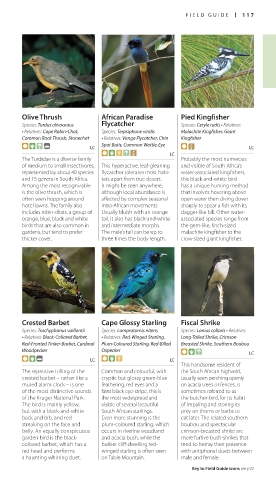
Olive Thrush African Paradise Pied Kingfisher
Species: Turdus olivaceous Flycatcher Species: Ceryle rudis • Relatives:
• Relatives: Cape Robin-Chat, Species: Terpsiphone viridis Malachite Kingfisher, Giant
Common Rock Thrush, Stonechat • Relatives: Vanga Flycatcher, Chin Kingfisher
LC Spot Batis, Common Wattle-Eye LC
LC
The Turdidae is a diverse family Probably the most numerous
of medium to small insectivores, This hyperactive, leaf-gleaning and visible of South Africa’s
represented by about 40 species flycatcher tolerates most habi- water-associated kingfishers,
and 15 genera in South Africa. tats apart from true desert. this black-and-white bird
Among the most recognizable It might be seen anywhere, has a unique hunting method
is the olive thrush, which is although local abundance is that involves hovering above
often seen hopping around affected by complex seasonal open water then diving down
hotel lawns. The family also intra-African movements. sharply to spear a fish with its
includes robin-chats, a group of Usu ally bluish with an orange dagger-like bill. Other water-
orange, blue, black and white tail, it also has black-and-white associated species range from
birds that are also common in and intermediate morphs. the gem-like, finch-sized
gardens, but tend to prefer The male’s tail can be up to malachite kingfisher to the
thicker cover. three times the body length. crow-sized giant kingfisher.
Crested Barbet Cape Glossy Starling Fiscal Shrike
Species: Trachyphonus vaillantii Species: Lamprotornis nitens Species: Lanius collaris • Relatives:
• Relatives: Black-Collared Barbet, • Relatives: Red-Winged Starling, Long-Tailed Shrike, Crimson-
Red-Fronted Tinker-Barbet, Cardinal Plum-Coloured Starling, Red-Billed Breasted Shrike, Southern Boubou
Woodpecker Oxpecker LC
LC LC
This handsome resident of
The repetitive trilling of the Common and colourful, with the South African highveld,
crested barbet – rather like a cryptic but glossy green-blue usually seen perching openly
muted alarm clock – is one feathering, red eyes and a on acacia trees or fences, is
of the most distinctive sounds faint black eye-stripe, this is sometimes referred to as
of the Kruger National Park. the most widespread and the butcher-bird, for its habit
The bird is mainly yellow, visible of several beautiful of impaling and storing its
but with a black-and-white South African starlings. prey on thorns or barbs to
back and bib, and red Even more stunning is the eat later. The related southern
streaking on the face and plum-coloured starling, which boubou and spectac ular
belly. An equally conspicuous occurs in riverine woodland crimson-breasted shrike are
garden bird is the black- and acacia bush, while the more furtive bush-shrikes that
collared barbet, which has a bulkier cliff-dwelling red- tend to betray their pres ence
red head and performs winged starling is often seen with antiphonal duets between
a haunting whirring duet. on Table Mountain. male and female.
Key to Field Guide icons see p72
116-117_EW_South_Africa.indd 117 21/05/2015 11:44

