


Page 118 - (DK Eyewitness) Travel Guide - South Africa
P. 118
116 WILD SOUTH AFRIC A
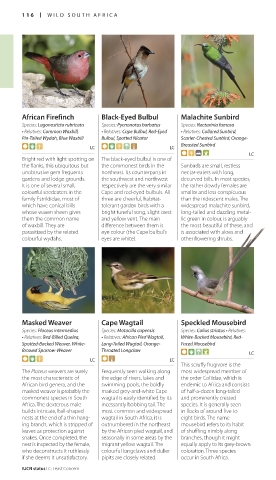
African Firefinch Black-Eyed Bulbul Malachite Sunbird
Species: Lagonosticta rubricata Species: Pycnonotus barbatus Species: Nectarinia famosa
• Relatives: Common Waxbill, • Relatives: Cape Bulbul, Red-Eyed • Relatives: Collared Sunbird,
Pin-Tailed Wydah, Blue Waxbill Bulbul, Spotted Nicator Scarlet-Chested Sunbird, Orange-
LC LC Breasted Sunbird
LC
Bright red with light spotting on The black-eyed bulbul is one of
the flanks, this ubiquitous but the commonest birds in the Sunbirds are small, restless
unobtrusive gem frequents northeast. Its counterparts in nectar-eaters with long,
gardens and lodge grounds. the southwest and northwest decurved bills. In most species,
It is one of several small, respectively are the very similar the rather dowdy females are
colour ful seedeaters in the Cape and red-eyed bulbuls. All smaller and less conspicuous
family Estrildidae, most of three are cheerful, habitat- than the iridescent males. The
which have conical bills tolerant garden birds with a widespread malachite sunbird,
whose waxen sheen gives bright tuneful song, slight crest long-tailed and dazzling metal-
them the common name and yellow vent. The main lic green in colour, is arguably
of waxbill. They are difference between them is the most beautiful of these, and
parasitized by the related eye colour (the Cape bulbul’s is associated with aloes and
colourful wydahs. eyes are white). other flowering shrubs.
Masked Weaver Cape Wagtail Speckled Mousebird
Species: Ploceus intermedius Species: Motacilla capensis Species: Colius striatus • Relatives:
• Relatives: Red-Billed Quelea, • Relatives: African Pied Wagtail, White-Backed Mousebird, Red-
Spotted-Backed Weaver, White- Long-Tailed Wagtail, Orange- Faced Mousebird
Browed Sparrow-Weaver Throated Longclaw LC
LC LC
This scruffy frugivore is the
The Ploceus weavers are surely Frequently seen walking along most widespread member of
the most characteristic of the edge of rivers, lakes and the order Coliidae, which is
African bird genera, and the swimming pools, the boldly endemic to Africa and consists
masked weaver is probably the marked grey-and-white Cape of half-a-dozen long-tailed
commonest species in South wagtail is easily identified by its and prominently crested
Africa. The dexterous male incessantly bobbing tail. The species. It is generally seen
builds intricate, ball-shaped most common and widespread in flocks of around five to
nests at the end of a thin hang- wagtail in South Africa, it is eight birds. The name
ing branch, which is stripped of outnumbered in the northeast mousebird refers to its habit
leaves as protection against by the African pied wagtail, and of shuffling nimbly along
snakes. Once completed, the seasonally in some areas by the branches, though it might
nest is inspected by the female, migrant yellow wagtail. The equally apply to its grey-brown
who deconstructs it ruthlessly colourful longclaws and duller coloration. Three species
if she deems it unsatisfactory. pipits are closely related. occur in South Africa.
IUCN status LC: Least Concern
116-117_EW_South_Africa.indd 116 21/05/2015 11:44

