


Page 69 - BBC Wildlife Volume 36 #06
P. 69
LEMON SHARKS


          MAGICAL MANGROVES

          Not only do mangrove forests ofer a safe nursery
          to lemon shark pups and many other fish, they also
          provide a host of essential ecological functions.

           MANGROVES HELP the fight         MANGROVES IMPROVE coastal
          1 against climate change by burying  4water quality, by absorbing excess
          masses of carbon deep in the soil.   nutrients and pollutants – including
          One study found that mangroves are   even the heavy metals that are
          more efective at capturing carbon   byproducts of mining, such as iron,
          than forests on land.         manganese and nickel.

            FOR LOCAL COMMUNITIES,         MANGROVES PROVIDE habitat for
          2mangroves can be a sustainable  5everything from tigers to saltwater
          source of timber, charcoal and food,   crocodiles and proboscis monkeys.
          such as oysters and honey.    Some of these species live virtually
                                        nowhere else, including birds such
            THE DEEP, TANGLED roots and   as the mangrove hummingbird and
          3stout trunks of mangroves protect   mangrove pitta.
          coastlines from erosion by waves and
          storms, the scale and frequency of
          which are likely to increase due to
          climate change.


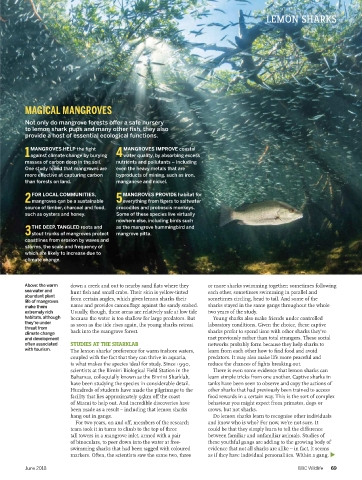
         Above: the warm  down a creek and out to nearby sand flats where they  or more sharks swimming together; sometimes following
         sea water and   hunt fish and small crabs. Their skin is yellow-tinted  each other, sometimes swimming in parallel and
         abundant plant
         life of mangroves  from certain angles, which gives lemon sharks their  sometimes circling, head to tail. And some of the
         make them       name and provides camouflage against the sandy seabed.  sharks stayed in the same gangs throughout the whole
         extremely rich   Usually, though, these areas are relatively safe at low tide  two years of the study.
         habitats, although  because the water is too shallow for large predators. But  Young sharks also make friends under controlled
         they’re under   as soon as the tide rises again, the young sharks retreat  laboratory conditions. Given the choice, these captive
         threat from
         climate change  back into the mangrove forest.                sharks prefer to spend time with other sharks they’ve
         and development                                               met previously rather than total strangers. These social
         often associated  STUDIES AT THE SHARKLAB                     networks probably form because they help sharks to
         with tourism.   The lemon sharks’ preference for warm inshore waters,  learn from each other how to find food and avoid
                         coupled with the fact that they can thrive in aquaria,  predators. It may also make life more peaceful and
                         is what makes the species ideal for study. Since 1990,  reduce the chances of fights breaking out.
                         scientists at the Bimini Biological Field Station in the  There is even some evidence that lemon sharks can
                         Bahamas, colloquially known as the Bimini Sharklab,  learn simple tricks from one another. Captive sharks in
                         have been studying the species in considerable detail.  tanks have been seen to observe and copy the actions of
                         Hundreds of students have made the pilgrimage to the  other sharks that had previously been trained to access
                         facility that lies approximately 95km off the coast  food rewards in a certain way. This is the sort of complex
                         of Miami to help out. And incredible discoveries have  behaviour you might expect from primates, dogs or
                         been made as a result – including that lemon sharks  crows, but not sharks.
                         hang out in gangs.                              Do lemon sharks learn to recognise other individuals
                           For two years, on and off, members of the research  and know who is who? For now, we’re not sure. It
                         team took it in turns to climb to the top of three   could be that they simply learn to tell the difference
                         tall towers in a mangrove inlet, armed with a pair  between familiar and unfamiliar animals. Studies of
                         of binoculars, to peer down into the water at free-  these youthful gangs are adding to the growing body of
                         swimming sharks that had been tagged with coloured  evidence that not all sharks are alike – in fact, it seems
                         markers. Often, the scientists saw the same two, three   as if they have individual personalities. Within a gang,
          June 2018                                                                                   BBC Wildlife  69

