


Page 71 - BBC Wildlife Volume 36 #06
P. 71
LEMON SHARKS


                                                                                     TAKING TURNS

                                                     Sickle-fin lemon sharks, close relatives   precise position in the hierarchy,” says
                                                     of lemon sharks from the Indo-Pacific,   Pierpaolo Brena, the study leader.
                                                     have been studied for a decade in   Higher-ranking sharks that got to eat
                                                     French Polynesia. Using cameras   first were less submissive and tended
                                                     set up around a bait box, scientists   not to veer of when swimming towards
                                                     recently discovered that they formed a   others. “To our knowledge, it’s the first
                                                     pecking order based, surprisingly, not   time that adult, free-ranging sharks
                                                     on body size but the shark’s behaviour.   have been shown to adapt to the
                                                     “Every shark in the group had a very   behaviour of their rivals,” Brena says.


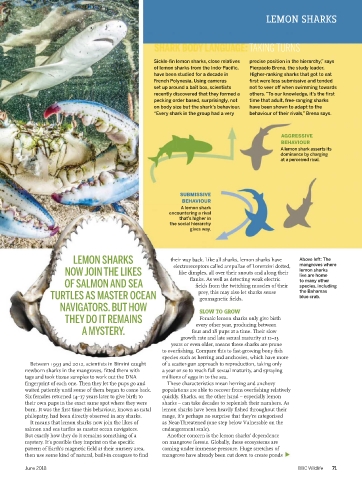
                                                                                                AGGRESSIVE
                                                                                                BEHAVIOUR
                                                                                                A lemon shark asserts its
                                                                                                dominance by charging
                                                                                                at a perceived rival.


                                                              SUBMISSIVE
                                                               BEHAVIOUR
                                                              A lemon shark
                                                          encountering a rival
                                                              that’s higher in
                                                          the social hierarchy
                                                                 gives way.


                          LEMON SHARKS                     their way back. Like  all sharks, lemon sharks have   Above left: The
                                                            electroreceptors ca lled ampullae of Lorenzini dotted,   mangroves where
                       NOW JOIN THE LIKES                     like dimples, all  over their snouts and along their   lemon sharks
                                                                                                      live are home
                                                                         well as detecting weak electric
                       OF SALMON AND SEA                         flanks. As w m the twitching muscles of their   to many other
                                                                   fields fro
                                                                                                      species, including
                                                                          is may also let sharks sense
                  TURTLES AS MASTER OCEAN                           prey, th gnetic fields.            the Bahamas
                                                                                                      blue crab.
                                                                     geomag
                     NAVIGATORS. BUT HOW
                                                                     SLOW  TO GROW
                       THEY DO IT REMAINS                            Female e lemon sharks only give birth
                                                                         her year, producing between
                                                                   every oth
                             A MYSTERY.                           four and 18
                                                                          8 pups at a time. Their slow
                                                                         d late sexual maturity at 11–13
                                                              growth rate and
                                                           years or even older,  means these sharks are prone
                                                        to overfishing. Compare e this to fast-growing bony fish
                                                        species such as herring  and anchovies, which have more
           Between 1993 and 2012, scientists in Bimini caught  of a scatter-gun approac ch to reproduction, taking only
          newborn sharks in the mangroves, fitted them with   a year or so to reach full l sexual maturity, and spraying
          tags and took tissue samples to work out the DNA  millions of eggs in to the sea.
          fingerprint of each one. Then they let the pups go and  These characteristics mean herring and anchovy
          waited patiently until some of them began to come back.  populations are able to recover from overfishing relatively
          Six females returned 14–17 years later to give birth to   quickly. Sharks, on the other hand – especially lemon
          their own pups in the exact same spot where they were  sharks – can take decades to replenish their numbers. As
          born. It was the first time this behaviour, known as natal  lemon sharks have been heavily fished throughout their
          philopatry, had been directly observed in any sharks.  range, it’s perhaps no surprise that they’re categorised
           It means that lemon sharks now join the likes of   as Near-Threatened (one step below Vulnerable on the
          salmon and sea turtles as master ocean navigators.   endangerment scale).
          But exactly how they do it remains something of a   Another concern is the lemon sharks’ dependence
          mystery. It’s possible they imprint on the specific   on mangrove forests. Globally, these ecosystems are
          pattern of Earth’s magnetic field at their nursery area,   coming under immense pressure. Huge stretches of
          then use some kind of natural, built-in compass to find  mangrove have already been cut down to create ponds
          June 2018                                                                                   BBC Wildlife  71

