


Page 70 - BBC Wildlife Volume 36 #06
P. 70
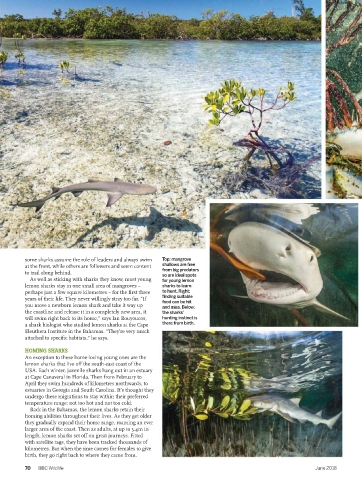
some sharks assume the role of leaders and always swim   Top: mangrove
          at the front, while others are followers and seem content   shallows are free
                                                        from big predators
          to trail along behind.
                                                        so are ideal spots
           As well as sticking with sharks they know, most young   for young lemon
          lemon sharks stay in one small area of mangroves –   sharks to learn
          perhaps just a few square kilometres – for the first three   to hunt. Right:
                                                        finding suitable
          years of their life. They never willingly stray too far. “If
                                                        food can be hit
          you move a newborn lemon shark and take it way up
                                                        and miss. Below:
          the coastline and release it in a completely new area, it   the sharks’
          will swim right back to its home,” says Ian Bouyoucos,   hunting instinct is
          a shark biologist who studied lemon sharks at the Cape   there from birth.
          Eleuthera Institute in the Bahamas. “They’re very much
          attached to specific habitats,” he says.
          HOMING SHARKS
          An exception to these home-loving young ones are the
          lemon sharks that live off the south-east coast of the
          USA. Each winter, juvenile sharks hang out in an estuary
          at Cape Canaveral in Florida. Then from February to
          April they swim hundreds of kilometres northwards, to
          estuaries in Georgia and South Carolina. It’s thought they
          undergo these migrations to stay within their preferred
          temperature range: not too hot and not too cold.
           Back in the Bahamas, the lemon sharks retain their
          homing abilities throughout their lives. As they get older
          they gradually expand their home range, roaming an ever
          larger area of the coast. Then as adults, at up to 3.4m in
          length, lemon sharks set off on great journeys. Fitted
          with satellite tags, they have been tracked thousands of
          kilometres. But when the time comes for females to give
          birth, they go right back to where they came from.
          70  BBC Wildlife                                                                                  June 2018

