


Page 64 - World of Animals - Issue #29
P. 64
Wildlife of the Alps


            The Alps


            under threat


            The alpine mountains are under threat from all
            angles. Humans are having an impact on the
            Alps due to an expansion of urban areas. With
            the rise of urbanisation comes an increased
            need for connective road and rail networks,
            contributing to noise, light, and air pollution. All
            of these can disrupt animals and fragment their
            habitat, damaging their long-term survival and
            reproductive success.
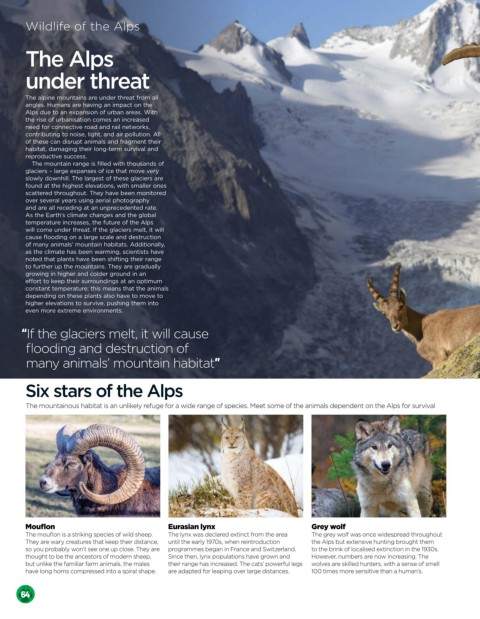
              The mountain range is filled with thousands of

            glaciers – large expanses of ice that move very
            slowly downhill. The largest of these glaciers are
            found at the highest elevations, with smaller ones
            scattered throughout. They have been monitored
            over several years using aerial photography
            and are all receding at an unprecedented rate.
            As the Earth’s climate changes and the global
            temperature increases, the future of the Alps
            will come under threat. If the glaciers melt, it will

            cause flooding on a large scale and destruction
            of many animals’ mountain habitats. Additionally,
            as the climate has been warming, scientists have
            noted that plants have been shifting their range
            to further up the mountains. They are gradually
            growing in higher and colder ground in an
            effort to keep their surroundings at an optimum
            constant temperature; this means that the animals
            depending on these plants also have to move to
            higher elevations to survive, pushing them into
            even more extreme environments.

           “If the glaciers melt, it will cause
            flooding and destruction of

            many animals’ mountain habitat”


            Six stars of the Alps


            The mountainous habitat is an unlikely refuge for a wide range of species. Meet some of the animals dependent on the Alps for survival


            Moufl on                                Eurasian lynx                          Grey wolf
            The mouflon is a striking species of wild sheep.   The lynx was declared extinct from the area   The grey wolf was once widespread throughout

            They are wary creatures that keep their distance,   until the early 1970s, when reintroduction   the Alps but extensive hunting brought them
            so you probably won’t see one up close. They are   programmes began in France and Switzerland.   to the brink of localised extinction in the 1930s.
            thought to be the ancestors of modern sheep,   Since then, lynx populations have grown and   However, numbers are now increasing. The
            but unlike the familiar farm animals, the males   their range has increased. The cats’ powerful legs   wolves are skilled hunters, with a sense of smell
            have long horns compressed into a spiral shape.  are adapted for leaping over large distances.  100 times more sensitive than a human’s.

           64

