


Page 66 - World of Animals - Issue #29
P. 66
L
L
L OST FOREVER
L
OST FOREVER
OST FOREVER
a
a
t
in
in
I
n
d
n
s
s
la
Pinta Island
P P t I la d
tortoise
Santa Cruz
Santa Cruz
Island
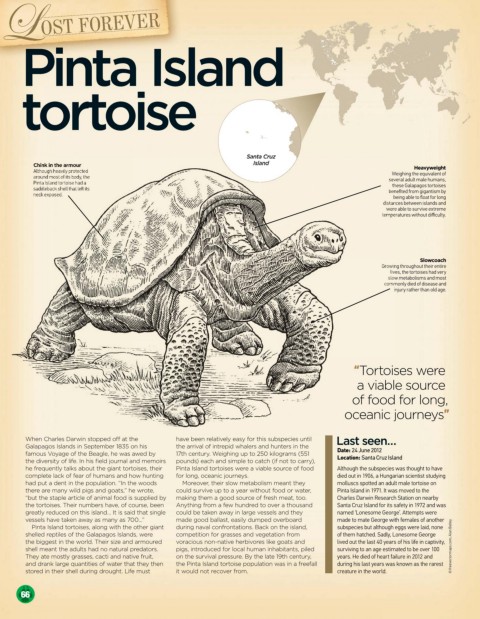
Chink in the armour Island Heavyweight
Chink in the armour
Although heavily protected Weighing the equivalent of
Although heavily protected
Weighing the equivalent of
around most of its body, the
around most of its body, the several adult male humans,
several adult male humans,
Pinta Island tortoise had a
Pinta Island tortoise had a these Galapagos tortoises
these Galapagos tortoises
saddleback shell that le its
saddleback shell that le its benefi ted from gigantism by
benefited from gigantism by
neck exposed. being able to float for long
neck exposed.
being able to fl
oat for long
distances between islands and
distances between islands and
were able to survive extreme
were able to survive extreme
temperatures without diffi culty.
temperatures without diffi culty.
Slowcoach
Growing throughout their entire
Growing throughout their entire
lives, the tortoises had very
lives, the tortoises had very
slow metabolisms and most
slow metabolisms and most
commonly died of disease and
commonly died of disease and
injury rather than old age.
injury rather than old age.
“Tortoises were
a viable source
of food for long,
oceanic journeys”
When Charles Darwin stopped off at the have been relatively easy for this subspecies until Last seen…
Galapagos Islands in September 1835 on his the arrival of intrepid whalers and hunters in the
famous Voyage of the Beagle, he was awed by 17th century. Weighing up to 250 kilograms (551 Date: 24 June 2012
the diversity of life. In his field journal and memoirs pounds) each and simple to catch (if not to carry), Location: Santa Cruz Island
he frequently talks about the giant tortoises, their Pinta Island tortoises were a viable source of food Although the subspecies was thought to have
complete lack of fear of humans and how hunting for long, oceanic journeys. died out in 1906, a Hungarian scientist studying
had put a dent in the population. “In the woods Moreover, their slow metabolism meant they molluscs spotted an adult male tortoise on
there are many wild pigs and goats,” he wrote, could survive up to a year without food or water, Pinta Island in 1971. It was moved to the
“but the staple article of animal food is supplied by making them a good source of fresh meat, too. Charles Darwin Research Station on nearby
the tortoises. Their numbers have, of course, been Anything from a few hundred to over a thousand Santa Cruz Island for its safety in 1972 and was
greatly reduced on this island… It is said that single could be taken away in large vessels and they named ‘Lonesome George’. Attempts were
vessels have taken away as many as 700...” made good ballast, easily dumped overboard made to mate George with females of another
Pinta Island tortoises, along with the other giant during naval confrontations. Back on the island, subspecies but although eggs were laid, none
shelled reptiles of the Galapagos Islands, were competition for grasses and vegetation from of them hatched. Sadly, Lonesome George
the biggest in the world. Their size and armoured voracious non-native herbivores like goats and lived out the last 40 years of his life in captivity,
shell meant the adults had no natural predators. pigs, introduced for local human inhabitants, piled surviving to an age estimated to be over 100 © freevectormaps.com; Alan Batley
They ate mostly grasses, cacti and native fruit, on the survival pressure. By the late 19th century, years. He died of heart failure in 2012 and
and drank large quantities of water that they then the Pinta Island tortoise population was in a freefall during his last years was known as the rarest
stored in their shell during drought. Life must it would not recover from. creature in the world.
66

