


Page 60 - Dinosaur (DK Eyewitness Books)
P. 60
Eggs and young


                                        DȪȯȰȴȢȶȳȴ ȩȢȵȤȩȦȥ ȧȳȰȮ ȩȢȳȥ ȴȩȦȭȭȦȥ eggs like those of
                                        birds and crocodiles. By studying a fossil eggshell’s shape and texture,
                                        paleontologists can tell which type of dinosaur laid the egg. Sometimes
                                       they even find a tiny skeleton inside the fossil egg. Such discoveries
                                      include the remains of whole nesting colonies of hadrosaurs and
                                    sauropods. Small dinosaurs probably sat on their eggs to warm them as

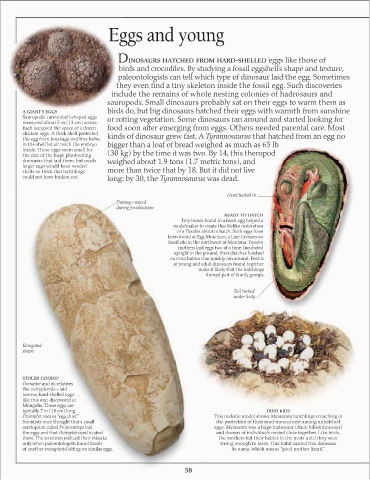
        A GIANT’S EGGS              birds do, but big dinosaurs hatched their eggs with warmth from sunshine
        Sauropods’ cannonball-shaped eggs   or rotting vegetation. Some dinosaurs ran around and started looking for
        measured about 5 in (13 cm) across.
        Each occupied the space of a dozen   food soon after emerging from eggs. Others needed parental care. Most
        chicken eggs. A thick shell protected   kinds of dinosaur grew fast. A Tyrannosaurus that hatched from an egg no
        the egg from breakage and tiny holes
        in the shell let air reach the embryo   bigger than a loaf of bread weighed as much as 65 lb
        inside. These eggs seem small for
        the size of the huge plant-eating   (30 kg) by the time it was two. By 14, this theropod
        dinosaurs that laid them, but much   weighed about 1.9 tons (1.7 metric tons), and
        larger eggs would have needed
        shells so thick that hatchlings    more than twice that by 18. But it did not live
        could not have broken out.   long: by 30, the Tyrannosaurus was dead.


                                                                            Head tucked in
                                        Damage caused
                                        during fossilization
                                                                           READY TO HATCH
                                                             Tiny bones found in a fossil egg helped a
                                                          modelmaker to create this lifelike restoration
                                                            of a Troodon about to hatch. Such eggs have
                                                         been found at Egg Mountain, a Late Cretaceous
                                                         fossil site in the northwest of Montana. Troodon
                                                            mothers laid eggs two at a time. Incubated
                                                          upright in the ground, their clutches hatched
                                                         out into babies that quickly ran around. Fossils
                                                          of young and adult dinosaurs found together
                                                                   make it likely that the hatchlings
                                                                     formed part of family groups.


                                                                              Tail tucked
                                                                              under body


        Elongated
        shape


        STOLEN GOODS?
        Oviraptor and its relatives—
        the oviraptorids—laid
        narrow, hard-shelled eggs
        like this one, discovered in
        Mongolia. These eggs are
        typically 7 in (18 cm) long.                                                     DINO KIDS
        Oviraptor means “egg thief.”                                    This realistic model shows Maiasaura hatchlings crouching in
        Scientists once thought that a small                             the protection of their mud-mound nest among unhatched
        ceratopsian called Protoceratops laid                           eggs. Maiasaura was a large hadrosaur (duck-billed dinosaur)
        the eggs and that Oviraptor used to steal                        and dozens of individuals nested close together. Like birds,
        them. The scientists realized their mistake                      the mothers fed their babies in the nests until they were
        only when paleontologists found fossils                           strong enough to leave. This habit earned this dinosaur
        of another oviraptorid sitting on similar eggs.                       its name, which means “good mother lizard.”


                                                              58

