


Page 64 - Dinosaur (DK Eyewitness Books)
P. 64
Rebuilding a dinosaur


                                          DȪȨȨȪȯȨ ȶȱ Ȣ ȥȪȯȰȴȢȶȳpȴ bones is just the first step toward
                                          learning what it looked like and putting it on show. Inside a museum
                                          laboratory, technicians called preparators start by sawing off the
                                          plaster jackets protecting the bones. If the bones are embedded
                                          in rock, the next step is to extract them carefully.
                                          Preparators chip away hard rock with chisels. They
                                          use powered tools like dentists’ drills for detailed
                                          work, and even acid for removing certain kinds of stone from
                                          around the fossils. Once the bones are cleaned, paleontologists
                                          can reconstruct the dinosaur’s skeleton by fitting them together.
                                          Modelmakers can then be guided by paleontologists in building
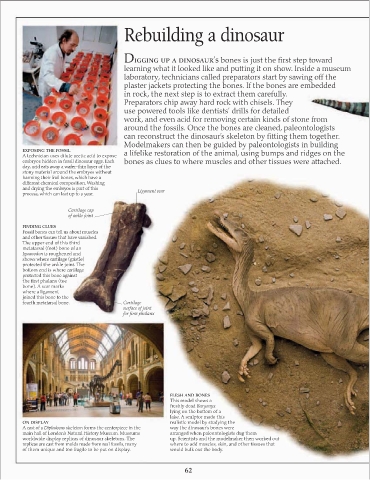
        EXPOSING THE FOSSIL               a lifelike restoration of the animal, using bumps and ridges on the
        A technician uses dilute acetic acid to expose
        embryos hidden in fossil dinosaur eggs. Each   bones as clues to where muscles and other tissues were attached.
        day, acid eats away a wafer-thin layer of the
        stony material around the embryos without
        harming their frail bones, which have a
        different chemical composition. Washing
        and drying the embryos is part of this
                                               Ligament scar
        process, which can last up to a year.

                        Cartilage cap
                        of ankle joint
        FINDING CLUES
        Fossil bones can tell us about muscles
        and other tissues that have vanished.
        The upper end of this third
        metatarsal (foot) bone of an
        Iguanodon is roughened and
        shows where cartilage (gristle)
        protected the ankle joint. The
        bottom end is where cartilage
        protected this bone against
        the first phalanx (toe
        bone). A scar marks
        where a ligament
        joined this bone to the
        fourth metatarsal bone.           Cartilage
                                          surface of joint
                                          for first phalanx


                                                         FLESH AND BONES
                                                         This model shows a
                                                         freshly dead Baryonyx
                                                         lying on the bottom of a
                                                         lake. A sculptor made this
        ON DISPLAY                                       realistic model by studying the
        A cast of a Diplodocus skeleton forms the centerpiece in the   way the dinosaur’s bones were
        main hall of London’s Natural History Museum. Museums   arranged when paleontologists dug them
        worldwide display replicas of dinosaur skeletons. The   up. Scientists and the modelmaker then worked out
        replicas are cast from molds made from real fossils, many   where to add muscles, skin, and other tissues that
        of them unique and too fragile to be put on display.  would bulk out the body.


                                                              62

