


Page 63 - Dinosaur (DK Eyewitness Books)
P. 63
THE FIND
      When excavating the
      bones of a dinosaur, the
      paleontologists first remove
      the bulk of rocks around the
      bones. Then they clear away
      the matrix (rocky material
      immediately surrounding the
      bones) as much as possible
      using hammers and chisels.
      Next they encase the bones
      in jackets made of sackcloth
      soaked in wet plaster. This
      sets hard quickly, forming a
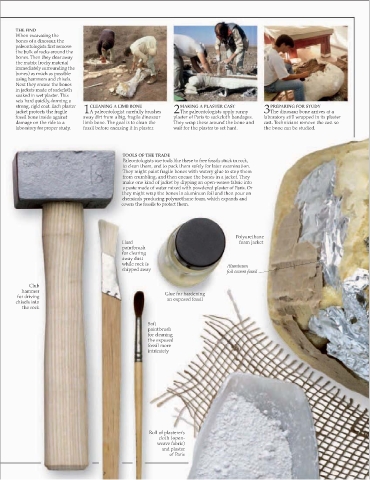
      strong, rigid coat. Each plaster   CLEANING A LIMB BONE  MAKING A PLASTER CAST      PREPARING FOR STUDY
      jacket protects the fragile   1A paleontologist carefully brushes  2The paleontologists apply runny   3The dinosaur bone arrives at a
      fossil bone inside against   away dirt from a big, fragile dinosaur   plaster of Paris to sackcloth bandages.   laboratory still wrapped in its plaster
      damage on the ride to a   limb bone. The goal is to clean the    They wrap these around the bone and   cast. Technicians remove the cast so
      laboratory for proper study.  fossil before encasing it in plaster.  wait for the plaster to set hard.  the bone can be studied.


                                          TOOLS OF THE TRADE
                                          Paleontologists use tools like these to free fossils stuck in rock,
                                          to clean them, and to pack them safely for later examination.
                                          They might paint fragile bones with watery glue to stop them
                                          from crumbling, and then encase the bones in a jacket. They
                                          make one kind of jacket by dipping an open-weave fabric into
                                          a paste made of water mixed with powdered plaster of Paris. Or
                                         they might wrap the bones in aluminum foil and then pour on
                                         chemicals producing polyurethane foam, which expands and
                                         covers the fossils to protect them.


                                                                               Polyurethane
                                         Hard                                   foam jacket
                                         paintbrush
                                         for clearing
                                         away dust
                                         while rock is                      Aluminum
                                         chipped away
                                                                            foil covers fossil
           Club
        hammer                                          Glue for hardening
       for driving                                      an exposed fossil
      chisels into
        the rock

                                                  Soft
                                                  paintbrush
                                                  for cleaning
                                                  the exposed
                                                  fossil more
                                                  intricately


                                                  Roll of plasterer’s
                                                      cloth (open-
                                                     weave fabric)
                                                       and plaster
                                                         of Paris

