


Page 58 - Dinosaur (DK Eyewitness Books)
P. 58
Feathered dinosaurs


        NȰȵ Ȣȭȭ ȥȪȯȰȴȢȶȳȴ ȩȢȥ ȴȤȢȭȺ ȴȬȪȯ—the skin of some was covered in down
        or feathers. The first evidence came in 1861 when a German scientist described
        Archaeopteryx, a primitive bird with wings, but a long, bony tail, clawed fingers,
        and teeth like those of theropods. In 1996, Chinese paleontologists discovered
        Sinosauropteryx, a small birdlike dinosaur with “dinofuzz”—a downy covering
        on its body. Then came more exciting finds—theropods with showy feathers
        and feathered arms that worked as wings for gliding, not flapping. The first
        featherlike structures were downy and were probably used for keeping the body
        warm. Feathers used for display and flight probably developed later. Early flying
        theropods evolved into the expert aerobatic dinosaurs that we call modern birds.            Feathered
                                                                                                    head


                                                         Toothy jaw
                                                                                                             Feathered
                                                                                                             arm


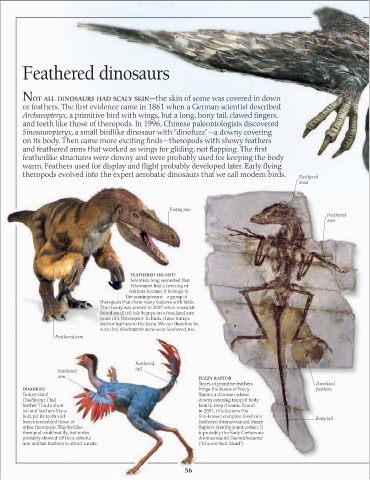
                                            FEATHERED OR NOT?
                                            Scientists long suspected that
                                            Velociraptor had a covering of
                                            feathers because it belongs to
                                           the maniraptorans—a group of
                                  theropods that share many features with birds.
                                  The theory was proved in 2007 when scientists
                                  found small tell-tale bumps on a fossilized arm
                                  bone of a Velociraptor. In birds, these bumps
                                  anchor feathers to the bone. We can therefore be
                                  sure that Velociraptor’s arms were feathered, too.
                   Feathered arm


                                              Feathered
                                              tail
                    Feathered
                    arm                                            FUZZY RAPTOR
                                                                   Traces of primitive feathers           Fossilized
        DINOBIRD                                                   fringe the bones of Fuzzy              feathers
        Turkey-sized                                               Raptor, a dinosaur whose
        Caudipteryx (“tail                                         downy covering trapped body
        feather”) had a short                                      heat to keep it warm. Found
        tail and feathers like a                                   in 2001, this became the
        bird, yet its teeth and                                    first-known complete fossil of a       Bony tail
        bones resembled those of                                   feathered dromaeosaurid. Fuzzy
        other theropods. This birdlike                             Raptor’s identity is not certain. It
        theropod could not fly, but males                          is probably the Early Cretaceous
        probably showed off their colorful                         dromaeosaurid Sinornithosaurus
        arm and tail feathers to attract a mate.                   (“Chinese bird lizard”).


                                                              56

