


Page 62 - Dinosaur (DK Eyewitness Books)
P. 62
Finding dinosaur fossils


                                                       HȰȸ ȥȰ ȧȰȴȴȪȭ ȩȶȯȵȦȳȴ discover the remains
                                                       of dinosaurs? First, they look for the right kinds of
                                                       fossil-bearing rocks. Sedimentary rocks like sandstones
                                                       that date from the Age of Dinosaurs often show up
                                                       most clearly in badlands (barren and eroded regions),
                                                       deserts, cliffs, and quarries. Paleontologists search these
                                                       places for unusual rock. What we might consider shiny
                                                       or spongy stones may be recognized by the experts as
                                                       scraps of dinosaur fossils—pieces that may have broken
                                                       off from a larger fossil such as a skull. Discovery is just
                                                       the start. A team of experts may work for weeks to
                                                       free a large fossil from its rocky tomb without
                                                       damaging it. Meanwhile, they measure,
                                                       map, and photograph each bone.


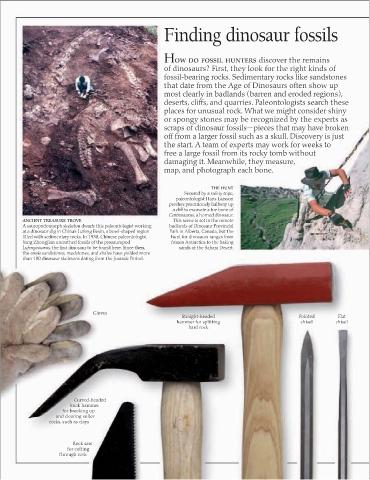
                                                                       THE HUNT
                                                              Secured by a safety rope,
                                                           paleontologist Hans Larsson
                                                         perches precariously halfway up
                                                          a cliff to excavate a toe bone of
                                                         Centrosaurus, a horned dinosaur.
        ANCIENT TREASURE TROVE                            This scene is set in the remote
        A sauropodomorph skeleton dwarfs this paleontologist working   badlands of Dinosaur Provincial
        at a dinosaur dig in China’s Lufeng Basin, a bowl-shaped region   Park in Alberta, Canada, but the
        filled with sedimentary rocks. In 1938, Chinese paleontologist   hunt for dinosaurs ranges from
        Yang Zhongjian unearthed fossils of the prosauropod   frozen Antarctica to the baking
        Lufengosaurus, the first dinosaur to be found here. Since then,   sands of the Sahara Desert.
        the area’s sandstones, mudstones, and shales have yielded more
        than 100 dinosaur skeletons dating from the Jurassic Period.


                                Gloves
                                                             Straight-headed                        Pointed      Flat
                                                           hammer for splitting                     chisel      chisel
                                                               hard rock


                         Curved-headed
                        brick hammer
                      for breaking up
                   and clearing softer
                 rocks, such as clays


                         Rock saw
                       for cutting
                     through rock

