


Page 44 - BBC Music (January 2020)
P. 44
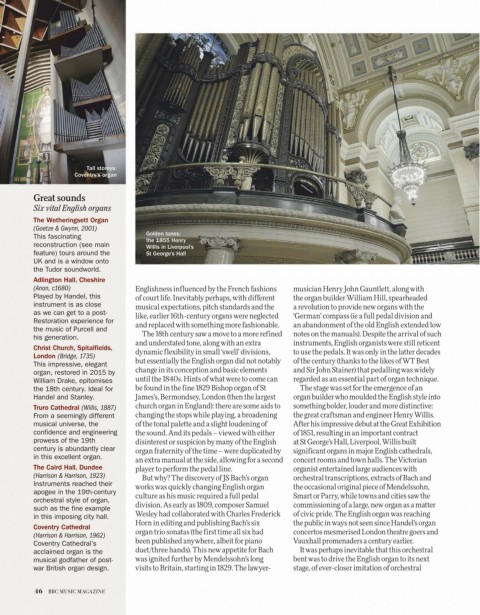
Tall storeys:
                           Coventry’s organ


             Great sounds
             Six vital English organs

             The Wetheringsett Organ
             (Goetze & Gwynn, 2001)
                                                    Golden tones:
             This fascinating
                                                    the 1855 Henry
             reconstruction (see main               Willis in Liverpool’s
             feature) tours around the              St George’s Hall
             UK and is a window onto
             the Tudor soundworld.
             Adlington Hall, Cheshire
             (Anon, c1680)                      Englishness influenced by the French fashions          musician Henry John Gauntlett, along with
             Played by Handel, this             of court life. Inevitably perhaps, with different      the organ builder William Hill, spearheaded
             instrument is as close             musical expectations, pitch standards and the          a revolution to provide new organs with the
             as we can get to a post-           like, earlier 16th-century organs were neglected       ‘German’ compass (ie a full pedal division and
             Restoration experience for         and replaced with something more fashionable.          an abandonment of the old English extended low
             the music of Purcell and
             his generation.                      The 18th century saw a move to a more refined        notes on the manuals). Despite the arrival of such
                                                and understated tone, along with an extra              instruments, English organists were still reticent
             Christ Church, Spitalfields,       dynamic flexibility in small ‘swell’ divisions,        to use the pedals. It was only in the latter decades
             London (Bridge, 1735)
             This impressive, elegant           but essentially the English organ did not notably      of the century (thanks to the likes of WT Best
             organ, restored in 2015 by         change in its conception and basic elements            and Sir John Stainer) that pedalling was widely
             William Drake, epitomises          until the 1840s. Hints of what were to come can        regarded as an essential part of organ technique.
             the 18th century. Ideal for        be found in the fine 1829 Bishop organ of St             The stage was set for the emergence of an
             Handel and Stanley.                James’s, Bermondsey, London (then the largest          organ builder who moulded the English style into
             Truro Cathedral (Willis, 1887)     church organ in England): there are some aids to       something bolder, louder and more distinctive:
             From a seemingly different         changing the stops while playing, a broadening         the great craftsman and engineer Henry Willis.
             musical universe, the              of the tonal palette and a slight loudening of         After his impressive debut at the Great Exhibition
             confidence and engineering         the sound. And its pedals – viewed with either         of 1851, resulting in an important contract
             prowess of the 19th                disinterest or suspicion by many of the English        at St George’s Hall, Liverpool, Willis built
             century is abundantly clear        organ fraternity of the time – were duplicated by      significant organs in major English cathedrals,
             in this excellent organ.           an extra manual at the side, allowing for a second     concert rooms and town halls. The Victorian
             The Caird Hall, Dundee             player to perform the pedal line.                      organist entertained large audiences with
             (Harrison & Harrison, 1923)          But why? The discovery of JS Bach’s organ            orchestral transcriptions, extracts of Bach and
             Instruments reached their          works was quickly changing English organ               the occasional original piece of Mendelssohn,
             apogee in the 19th-century         culture as his music required a full pedal             Smart or Parry, while towns and cities saw the
             orchestral style of organ,
             such as the fine example           division. As early as 1809, composer Samuel            commissioning of a large, new organ as a matter
             in this imposing city hall.        Wesley had collaborated with Charles Frederick         of civic pride. The English organ was reaching
                                                Horn in editing and publishing Bach’s six              the public in ways not seen since Handel’s organ
             Coventry Cathedral
             (Harrison & Harrison, 1962)        organ trio sonatas (the first time all six had         concertos mesmerised London theatre goers and
             Coventry Cathedral’s               been published anywhere, albeit for piano              Vauxhall promenaders a century earlier.
             acclaimed organ is the             duet/three hands). This new appetite for Bach            It was perhaps inevitable that this orchestral
             musical godfather of post-         was ignited further by Mendelssohn’s long              bent was to drive the English organ to its next
             war British organ design.          visits to Britain, starting in 1829. The lawyer-       stage, of ever-closer imitation of orchestral


             46   BBC MUSIC MAGAZINE

