


Page 45 - BBC Music (January 2020)
P. 45
The English organ


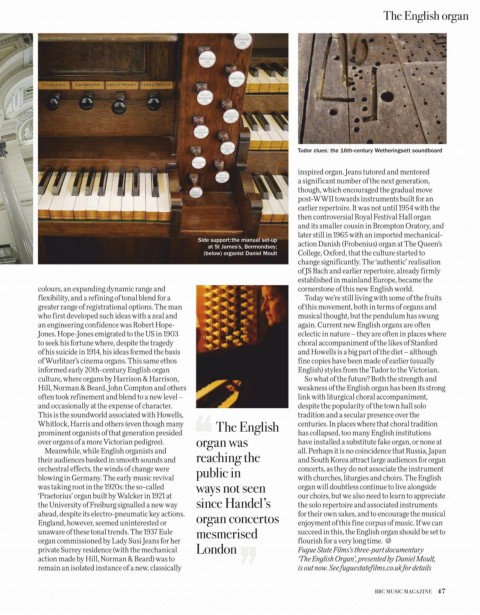
                                                                                                         Tudor clues: the 16th-century Wetheringsett soundboard


                                                                                                         inspired organ. Jeans tutored and mentored
                                                                                                         a significant number of the next generation,
                                                                                                         though, which encouraged the gradual move
                                                                                                         post-WWII towards instruments built for an
                                                                                                         earlier repertoire. It was not until 1954 with the
                                                                                                         then controversial Royal Festival Hall organ
                                                                                                         and its smaller cousin in Brompton Oratory, and
                                                                                                         later still in 1965 with an imported mechanical-
                                                                      Side support:the manual set-up
                                                                         at St James’s, Bermondsey;      action Danish (Frobenius) organ at The Queen’s
                                                                        (below) organist Daniel Moult    College, Oxford, that the culture started to
                                                                                                         change significantly. The ‘authentic’ realisation
                                                                                                         of JS Bach and earlier repertoire, already firmly
                                                                                                         established in mainland Europe, became the
              colours, an expanding dynamic range and                                                    cornerstone of this new English world.
              flexibility, and a refining of tonal blend for a                                             Today we’re still living with some of the fruits
              greater range of registrational options. The man                                           of this movement, both in terms of organs and
              who first developed such ideas with a zeal and                                             musical thought, but the pendulum has swung
              an engineering confidence was Robert Hope-                                                 again. Current new English organs are often
              Jones. Hope-Jones emigrated to the US in 1903                                              eclectic in nature – they are often in places where
              to seek his fortune where, despite the tragedy                                             choral accompaniment of the likes of Stanford
              of his suicide in 1914, his ideas formed the basis                                         and Howells is a big part of the diet – although
              of Wurlitzer’s cinema organs. This same ethos                                              fine copies have been made of earlier (usually
              informed early 20th-century English organ                                                  English) styles from the Tudor to the Victorian.
              culture, where organs by Harrison & Harrison,                                                So what of the future? Both the strength and
              Hill, Norman & Beard, John Compton and others                                              weakness of the English organ has been its strong
              often took refinement and blend to a new level –                                           link with liturgical choral accompaniment,
              and occasionally at the expense of character.                                              despite the popularity of the town hall solo
              This is the soundworld associated with Howells,                                            tradition and a secular presence over the
              Whitlock, Harris and others (even though many                 The English                  centuries. In places where that choral tradition
              prominent organists of that generation presided       ‘‘                                   has collapsed, too many English institutions
              over organs of a more Victorian pedigree).             organ was                           have installed a substitute fake organ, or none at
                Meanwhile, while English organists and                                                   all. Perhaps it is no coincidence that Russia, Japan
              their audiences basked in smooth sounds and            reaching the                        and South Korea attract large audiences for organ
              orchestral effects, the winds of change were           public in                           concerts, as they do not associate the instrument
              blowing in Germany. The early music revival                                                with churches, liturgies and choirs. The English
              was taking root in the 1920s: the so-called            ways not seen                       organ will doubtless continue to live alongside
              ‘Praetorius’ organ built by Walcker in 1921 at                                             our choirs, but we also need to learn to appreciate
              the University of Freiburg signalled a new way         since Handel’s                      the solo repertoire and associated instruments
              ahead, despite its electro-pneumatic key actions.      organ concertos                     for their own sakes, and to encourage the musical
              England, however, seemed uninterested or                                                   enjoyment of this fine corpus of music. If we can
              unaware of these tonal trends. The 1937 Eule           mesmerised                          succeed in this, the English organ should be set to
              organ commissioned by Lady Susi Jeans for her                                              flourish for a very long time.
              private Surrey residence (with the mechanical          London                              Fugue State Films’s three-part documentary
              action made by Hill, Norman & Beard) was to                                                ‘The English Organ’, presented by Daniel Moult,
              remain an isolated instance of a new, classically                     ’’                   is out now. See fuguestatefilms.co.uk for details


                                                                                                                                    BBC MUSIC MAGAZINE   47

