


Page 151 - How It Works - Book Of Amazing Answers To Curious Questions, Volume 05-15
P. 151
History


            How was ocean                                                                    How did


            depth                          first                                              people stay

                                                                                             clean?

            measured?                                                                        The gruesome practices
                                                                                             that were once
                                                                                             considered healthy!

                                                                                               Urine mouthwash
             Explore the clever methods used to take the first                                1 Ammonia, a common ingredient
                                                                                             of household cleaners, is also found
             measurements of the sea floor                                                    in urine, and so the Romans used it
                                                                                             to clean their clothes. However, they
                  he first evidence of humans attempting to   but in 1872 the first wide-scale study of the world’s   also believed its stain removing
                  measure the depth of the oceans can be seen   oceans began. On its four-year expedition, the HMS   powers could clean and whiten
            Tin Egyptian tomb paintings from 1800 BCE.   Challenger took 360 depth readings of the sea floor   teeth, and so they regularly gargled
             The images show a man on a boat dipping a   using a variety of sounding devices. These devices   with it as mouthwash.
             sounding pole (a long rod used to measure depths)   used a weight to pull a sounding line to the seafloor
             into the water and measuring how far it goes in   and collected samples from the seabed in the
             before it reaches the bottom. This technique didn’t   process. The findings helped to identify underwater   Toilet closets
             change much for the next several thousand years,   mountain ranges and trenches, as well as   2 In medieval houses, toilets were
             with the pole simply switched for a rope with a   thousands of new marine species, forming the   basically a bowl covered by a slab of
             weight on the end.                     basis of modern oceanography. However, it wasn’t   wood with a hole in the middle.
              Most of the measurements were taken in shallow   until 1914 that sonar was first used to take more   They could usually be found in
             areas to identify near-shore hazards for shipping,   accurate measurements.
                                                                                             closets called garderobes, and
                                                                                             people would often keep their
                                                                                             clothes in their as the smell helped
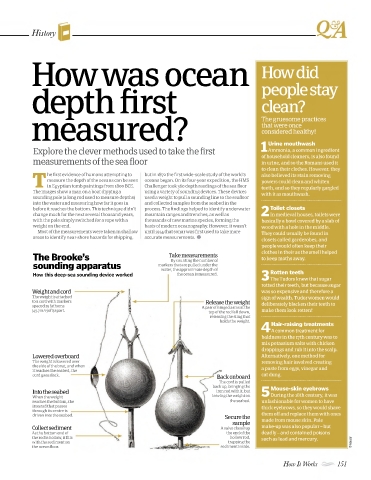
             The Brooke’s                                   Take measurements                to keep moths away.
                                                             By counting the number of
             sounding apparatus                          markers that are pulled under the
                                                          water, the approximate depth of
             How this deep-sea sounding device worked          the ocean is measured.           Rotten teeth
                                                                                             3 The Tudors knew that sugar
                                                                                             rotted their teeth, but because sugar
            Weight and cord                                                                  was so expensive and therefore a
            The weight is attached                                                           sign of wealth, Tudor women would
            to a cord with markers                                       Release the weight
            spaced 25 fathoms                                           A pair of hinged arms at the   deliberately blacken their teeth to
            (45.7m/150ft) apart.                                          top of the rod fall down,   make them look rotten!
                                                                           releasing the sling that
                                                                              holds the weight.
                                                                                                Hair-raising treatments
                                                                                             4 A common treatment for
                                                                                             baldness in the 17th century was to
                                                                                             mix potassium salts with chicken
                                                                                             droppings and rub it into the scalp.
            Lowered overboard                                                                Alternatively, one method for
            The weight is lowered over                                                       removing hair involved creating
            the side of the boat, and when
            it reaches the seabed, the                                                       a paste from eggs, vinegar and
            cord goes slack.                                                 Back onboard    cat dung.
                                                                              The cord is pulled
                                                                            back up, bringing the   Mouse-skin eyebrows
            Into the seabed                                                  iron rod with it, but
            When the weight                                                 leaving the weight on  5 During the 18th century, it was
            reaches the bottom, the                                               the seabed.   unfashionable for women to have
            iron rod that passes                                                             thick eyebrows, so they would shave
            through its centre is
            driven into the seabed.                                             Secure the   them off and replace them with ones
                                                                                   sample    made from mouse skin. Pale
            Collect sediment                                                   A valve closes up   make-up was also popular – but
            As the bottom end of                                                 the end of the   deadly – and contained poisons
            the rod is hollow, it fills                                            hollow rod,   such as lead and mercury.
            with the sediment on                                                 trapping the                                © Alamy
            the ocean floor.                                                    sediment inside.

                                                                                                     How It Works        151

