


Page 154 - How It Works - Book Of Amazing Answers To Curious Questions, Volume 05-15
P. 154
How was the post-


          WWII housing


          crisis solved?


          How this prefabulous plan solved the post-war
          housing crisis

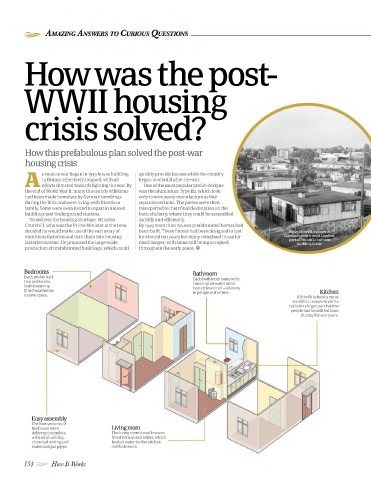
                s soon as war began in 1939 house building   quickly provide houses while the country
                in Britain effectively stopped, with all   began to rebuild after the war.

          A efforts directed towards fighting the war. By   One of the most popular prefab designs
          the end of World War II, many thousands of Britons   was the aluminium Type B2, which took
          had been made homeless by German bombings   only 12 minutes to manufacture as four
          during the Blitz and were living with friends or   separate sections. The pieces were then

          family. Some were even forced to squat in unused   transported to their final destination on the
          buildings and Underground stations.     back of a lorry, where they could be assembled
           To address the housing shortage, Winston   quickly and effi ciently.
          Churchill, who was the Prime Minister at the time,   By 1949 more than 156,000 prefabricated homes had
          decided he would make use of the vast array of   been built. These homes had been designed to last   Rows of prefab houses in
          munitions factories and turn them into housing   for around ten years but many remained in use for   Clapham, south-west London,
                                                                                                      part of Britain’s post-war
          factories instead. He proposed the large-scale   much longer, with some still being occupied   building boom
          production of prefabricated buildings, which could   throughout the early 2000s.


          Bedrooms                                                   Bathroom
          Each prefab had                                            Each bathroom came with
          two bedrooms,                                              running hot water and a
          both featuring                                             heated towel rail – a luxury
          fi tted wardrobes                                           to people at the time.                      Kitchen
          to save space.                                                                                 A fitted kitchen came as

                                                                                                        standard, complete with a
                                                                                                       built-in refrigerator that few
                                                                                                       people had benefi tted from
                                                                                                           during the war years.


            Easy assembly
            The four sections of
            the house were              Living room
            delivered complete          The living room’s coal fi re was
            with all plumbing,          fitted with a back boiler, which

            electrical wiring and       heated water for the kitchen
            water and gas pipes.        and bathroom.
          154       How It Works

