


Page 156 - How It Works - Book Of Amazing Answers To Curious Questions, Volume 05-15
P. 156
Who invented the


          pencil sharpener?


          Discover the French engineers and the                                                               The iconic ‘prism’
                                                                                                              pencil sharpener
                                                                                                              dates back to 1847
          American tycoon behind the pencil sharpener
               lthough the exact origins of the pencil   The mechanism we’re familiar with today
               are uncertain, its growing popularity   came in 1847 from another Frenchman, Therry
         Ademanded a far less time-consuming   des Estwaux, who invented a cone-shaped
          and far more precise method of sharpening it   device with a single blade that when turned
          than to slash away with a knife.    would neatly and evenly shave away at the
           The first attempt came in 1828 from French   pencil on all sides.

          mathematician Bernard Lassimone, who   The French may have paved the way, but it
          placed two blades at 90 degree angles on a   was America that made waves. In the 1850s, US
          block of wood, but this method of grinding   inventor Walter K Foster mass-produced a
          down the pencil to a point wasn’t any faster   similar cone design and by 1857 his company
          than the traditional method.        was cranking out 7,200 sharpeners a day.


           When did the


           ‘butcher crocodile’


           roam Earth?


            The ‘Carolina Butcher’ topped the
            food chain 231 million years ago

                   hen the supercontinent Pangaea was breaking
                   apart, 2.7-metre (nine-foot) tall, sharp-toothed
           Wcreatures roamed the area that would become
           North Carolina in North America. Palaeontologists have
           recently discovered parts of the skeleton belonging to
           Carnufex carolinensis, an ancestor of today’s crocodiles.
           Nicknamed the ‘Carolina Butcher’, it is believed to have
           used its blade-like teeth to slice flesh from its prey,

           likely to have been armoured reptiles and the early
           relatives of large mammals. As its forearms were
           so short, it is also suspected the creature
           walked on two legs, much like a T-rex.

                                                                                                                         © Corbis; Jorge Gonzalez; NASA


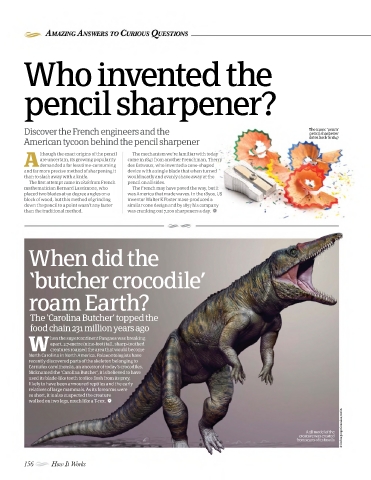
                                                                                                             A 3D model of the
                                                                                                          creature was created
                                                                                                         from scans of its fossils


          156       How It Works

