


Page 155 - How It Works - Book Of Amazing Answers To Curious Questions, Volume 05-15
P. 155
History


            How was wine made


            in          Ancient                                 Israel?


            Thousands of grapes and a whole lot of manpower was needed to make
            the Israelites’ favourite beverage

               srael’s hot, sunny climate and mountainous   ‘wine presses’ cut into the rocky ground for   would be collected in leather bags called
               landscape makes it the perfect place for   fermentation. First, they were tipped into what   wineskins or big jars called amphorae. These
            Igrowing grapes. In ancient times, it was   was called a ‘treading pool’ where vineyard   were often coated with resin, which helped to
            situated along a wine-trading route, which   workers would tread on the grapes with their   preserve the wine and gave it a woody fl avour.
            brought winemaking knowledge and infl uence   bare feet to crush them. The juice would then   Olive oil was then poured on top of the wine to

            to the area. People would drink about a litre of   flow through a channel into a vat, where the   prevent exposure to the air, and the jars were
            wine a day, so knowing how to make lots of wine   fermentation process would take place.   sealed with more resin or clay. The wine would
            fast was a very good skill to have.     The yeast on the skin of the grapes would react   be stored in cool, dark cellars for months or even
              The ancient Israelites harvested the grapes at   with the sugars in the juice and turn them into   years, and eventually sold in Israeli markets or
            the height of summer, and then brought them to   alcohol. Once fermentation was over, the wine   exported to foreign lands.


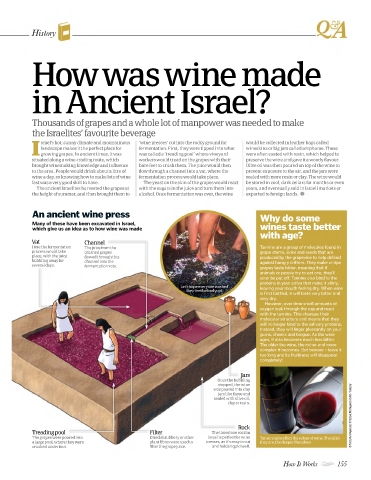
            An ancient wine press                                                           Why do some
            Many of these have been excavated in Israel,
            which give us an idea as to how wine was made                                   wines taste better
                                                                                            with age?
            Vat                Channel
            Here the fermentation   The juice from the                                      Tannins are a group of molecules found in
            process would take   crushed grapes                                             grape stems, skins and seeds that are
            place, with the juice   flowed through this                                      produced by the grapevine to help defend

            bubbling away for   channel into the                                            against hungry critters. They make unripe
            several days.      fermentation vats.                                           grapes taste bitter, meaning that if
                                                                                            animals or people try to eat one, they’ll
                                                                                            soon be put off. Tannins also bind to the
                                                                                            proteins in your saliva that make it slimy,
                                                                Let's hope everyone washed   leaving your mouth feeling dry. When wine
                                                                   their feet beforehand
                                                                                            is first bottled, it will taste very bitter and

                                                                                            very dry.
                                                                                              However, over time small amounts of
                                                                                            oxygen leak through the cap and react
                                                                                            with the tannins. This changes their
                                                                                            molecular structure and means that they
                                                                                            will no longer bind to the salivary proteins.
                                                                                            Instead, they will linger pleasantly on your
                                                                                            gums, cheeks and tongue. As the wine
                                                                                            ages, it also becomes much less bitter.
                                                                                            The older the wine, the richer and more
                                                                                            complex it becomes. But beware – leave it
                                                                                            too long and its fruitiness will disappear
                                                                                            completely!

                                                                                      Jars
                                                                             Once the bubbling
                                                                              stopped, the wine
                                                                            was poured into clay
                                                                              jars like these and
                                                                            sealed with olive oil,
                                                                                 clay or resin.


                                                                                     Rock                                   © Tom/Art Agency; Prisma Bildagentur AG / Alamy
            Treading pool                             Filter                The limestone rock in
            The grapes were poured into               Dried shrubbery or other   Israel is perfect for wine   Tannins also affect the colour of wine. The older

            a large pool, where they were             plant fibres were used to   presses, as it’s easy to cut   they are, the deeper the colour
            crushed under foot.                       filter the grape juice.  and holds liquid well.

                                                                                                     How It Works        155

