


Page 169 - How It Works - Book Of Amazing Answers To Curious Questions, Volume 05-15
P. 169
History


            How did stirling


            engines work?                                                                                        Heat source

                    Another dimension
                                                                                                               Heat is added to the
                                                                                                              right-hand cylinder,
                                                                                                               expanding the gas
            How does this 200-year-old design                                                                    and pushing the
                                                                                                                   work piston.
            convert heat into mechanical energy?

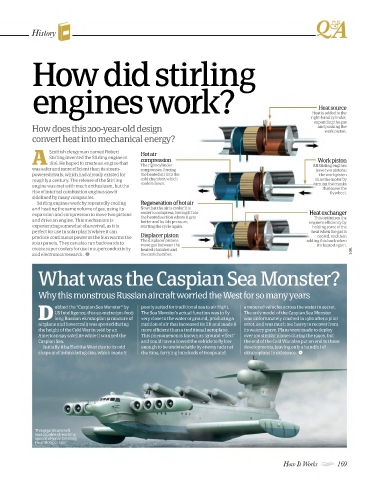
                  Scottish clergyman named Robert   Hot air
                  Stirling invented the Stirling engine in   compression
                                                                                                                 Work piston
            A 816. He hoped to create an engine that   The right cylinder                                      All Stirling engines
                  1
            was safer and more efficient than its steam-  compresses, forcing                                    have two pistons;
            powered rivals, which had already existed for   the heated air into the                              the work piston
            roughly a century. The release of the Stirling   cold chamber, which                                runs the motor by
                                                  cools it down.
            engine was met with much enthusiasm, but the                                                       turning the cranks
                                                                                                                  that move the
            rise of internal combustion engines saw it                                                               flywheel.
            sidelined by many companies.
              Stirling engines work by repeatedly cooling   Regeneration of hot air
            and heating the same volume of gas, using its   Now that the air is cooler it is
            expansion and compression to move two pistons   easier to compress, forcing it into               Heat exchanger
                                                  the heated section where it gets
                                                                                                               This optimises the
            and drive an engine. This mechanism is   hotter and builds pressure,                              engine’s efficiency by
            experiencing somewhat of a revival, as it is   starting the cycle again.                           holding some of the
            perfect for use in solar plants where it can                                                      heat when the gas is
                                                                                                                 cooled, and then
            produce continuous power as the Sun warms the   Displacer piston                                 adding this back when
                                                  The displacer pistons
            solar panels. They can also run backwards to   move gas between the                                 it’s heated again.
            create super coolers for use in superconductivity   heated chamber and                                           © SPL
            and electronics research.             the cool chamber.
               What was the Caspian Sea Monster?


               Why this monstrous Russian aircraft worried the West for so many years

                    ubbed the “Caspian Sea Monster” by   poorly suited for traditional sea to air flight.   armoured vehicles across the water in secret.
                    US Intelligence, this 92-metre (301-foot)   The Sea Monster’s actual function was to fly   The only model of the Caspian Sea Monster
              Dlong Russian ekranoplan (a mixture of   very close to the water or ground, producing a   was unfortunately crashed in 1980 after a pilot
               airplane and hovercraft) was spotted during   cushion of air that increased its lift and made it   error, and was much too heavy to recover from
               the height of the Cold War in 1966 by an   more efficient than a traditional aeroplane.   its watery grave. Plans were made to deploy
               American spy satellite while it scanned the   This phenomenon is known as ‘ground-effect’   over 100 similar planes during the 1990s, but
               Caspian Sea.                        and could have allowed the vehicle to fly low   the end of the Cold War also put an end to these
                Initially it baffled the West due to its odd   enough to be undetectable by enemy radar at   developments, leaving only a handful of
               shape and intimidating size, which made it   the time, ferrying hundreds of troops and   ekranoplans in existence.


             This gigantic aircraft
             was capable of reaching
             speeds of 500 kilometres
             (311 miles) per hour


                                                                                                     How It Works        169

