


Page 22 - How It Works - Book Of Amazing Answers To Curious Questions, Volume 05-15
P. 22
How do monarch


         butterfl                              ies            live?


         The butterfly king makes a spectacular migration,

         guided by instinct and an internal compass

               he monarch is one of the most recognisable and   Metamorphosis                          Egg
               beloved butterflies in the world. It is also one of the                                 Female monarchs lay
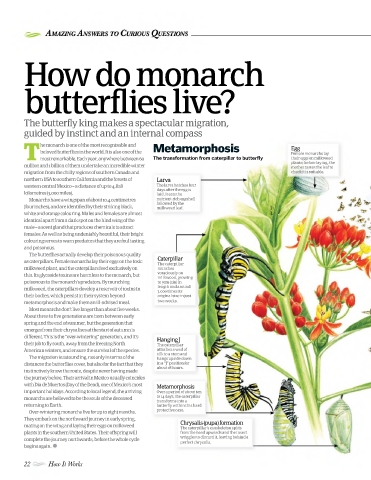
         Tmost remarkable. Each year, anywhere between 60   The transformation from caterpillar to butterfl y  their eggs on milkweed
                                                                                                       plants; before laying, the
          million and 1 billion of them undertake an incredible winter                                 mother tastes the leaf to
          migration from the chilly regions of southern Canada and                                     check it is suitable.
          northern USA to southern California and the forests of   Larva
          western central Mexico – a distance of up to 4,828   The larva hatches four
                                                        days after the egg is
          kilometres (3,000 miles).                     laid. It eats the
           Monarchs have a wingspan of about 10.4 centimetres   nutrient-rich eggshell
                                                        followed by the
          (four inches), and are identified by their striking black,   milkweed leaf.
          white and orange colouring. Males and females are almost
          identical apart from a dark spot on the hind wing of the
          male – a scent gland that produces chemicals to attract
          females. As well as being undeniably beautiful, their bright
          colouring serves to warn predators that they are foul tasting
          and poisonous.
           The butterflies actually develop their poisonous quality
          as caterpillars. Female monarchs lay their eggs on the toxic   Caterpillar
                                                        The caterpillar
          milkweed plant, and the caterpillars feed exclusively on   munches
          this. Its glycoside toxins are harmless to the monarch, but   voraciously on
                                                        milkweed, growing
          poisonous to the monarch’s predators. By munching   to 5cm (2in) in
          milkweed, the caterpillars develop a reservoir of toxins in   length and around
                                                        3,000 times its
          their bodies, which persist in their system beyond   original size in just
          metamorphosis and make them an ill-advised meal.  two weeks.
           Most monarchs don’t live longer than about five weeks.
          About three to five generations are born between early
          spring and the end of summer, but the generation that
          emerges from their chrysalises at the start of autumn is
          different. This is the “over-wintering” generation, and it’s   Hanging J
          their job to fly south, away from the freezing North   The caterpillar
          American winters, and ensure the survival of the species.  attaches a wad of
                                                        silk to a stem and
           The migration is astounding, not only in terms of the   hangs upside down
          distances the butterflies cover, but also for the fact that they   in a “J” position for
                                                        about 18 hours.
          instinctively know the route, despite never having made
          the journey before. Their arrival in Mexico usually coincides
          with Día de Muertos (Day of the Dead), one of Mexico’s most   Metamorphosis
          important holidays. According to local legend, the arriving   Over a period of about ten
          monarchs are believed to be the souls of the deceased   to 14 days, the caterpillar
                                                        transforms into a
          returning to Earth.                           butterfly within this hard

           Over-wintering monarchs live for up to eight months.   protective case.
          They embark on the northward journey in early spring,
          mating on the wing and laying their eggs on milkweed   Chrysalis (pupa) formation
                                                                The caterpillar’s exoskeleton splits
          plants in the southern United States. Their offspring will   from the head upwards and the insect
          complete the journey northwards, before the whole cycle   wriggles to discard it, leaving behind a
                                                                perfect chrysalis.
          begins again.

          22       How It Works

