


Page 68 - How It Works - Book Of Amazing Answers To Curious Questions, Volume 05-15
P. 68
Pain                                                                       Numbing the pain

          (nociception)                                                              Have you ever put your finger in your mouth after

                                                                                     shutting it in a door, or grabbed hold of your foot after
          This sense allows us to tell the difference                                stubbing your toe? Incoming signals from our other
                                                                                     senses can switch off pain signals, preventing some of
          between a harmless touch and potential                                     them from reaching the brain.
          damage to keep our bodies safe
           pecialised nerve endings called                                                               Projection cells
         Snociceptors are found in the skin and
          organs. Unlike normal sensory nerves,
          these are not activated by low-level
          stimulation, and instead wait until the
          temperature, pressure or level of a toxic
          substance is enough to cause the body
          harm. Activation of these nerves can trigger
          a swift withdrawal reflex, prompting us to
          move away from the harmful stimulus, and                                                       Inhibitory neuron
          in the long term it acts as a deterrent,
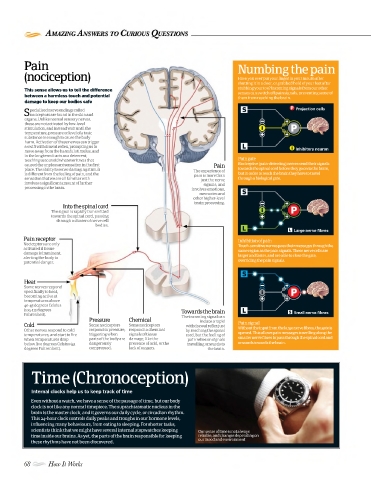
          teaching us to avoid whatever it was that                                  Pain gate
          caused the unpleasant sensation in the first                      Pain     Nociceptive (pain-detecting) nerves send their signals
          place. The ability to sense damaging stimuli               The experience of   towards the spinal cord before they go on to the brain,
          is different from the feeling of pain, and the             pain is more than   but in order to reach the brain they have to travel
          sensation that we are all familiar with                       just the nerve   through a biological gate.
          involves a significant amount of further                       signals, and
          processing in the brain.                                  involves emotions,
                                                                       memories and
                                                                     other higher-level
                                                                     brain processing.
                       Into the spinal cord
                   The signal is rapidly transmitted
                   towards the spinal cord, passing
                     through a cluster of nerve cell
                                   bodies.
                                                                                                        Large nerve fi bres
         Pain receptor                                                               Inhibition of pain
         Nociceptors are only                                                        Touch-sensitive nerves pass their messages through the
         activated if tissue                                                         same region as the pain signals. These nerve cells are
         damage is imminent,                                                         larger and faster, and are able to close the gate,
         alerting the body to
         potential danger.                                                           overriding the pain signals.


          Heat
          Some nerves respond

          specifically to heat,
          becoming active at
          temperatures above
          40-45 degrees Celsius
          (104-113 degrees                                       Towards the brain
          Fahrenheit).                                           The incoming signal can                Small nerve fi bres
                                Pressure      Chemical                 induce a rapid
          Cold                  Some nociceptors   Some nociceptors   withdrawal refl ex just   Pain signal
          Other nerves respond to cold   respond to pressure,  respond to chemical   by reaching the spinal   Without the input from the large nerve fibres, the gate is
          temperatures, and start to fi re   triggering when   signals of tissue   cord, but the feeling of   opened. This allows pain messages travelling along the
          when temperatures drop   parts of the body are  damage, like the   pain relies on signals   smaller nerve fibres to pass through the spinal cord and

          below five degrees Celsius (41   dangerously   presence of acid, or the   travelling onwards to   onwards towards the brain.
          degrees Fahrenheit).  compressed.   lack of oxygen.             the brain.

            Time (Chronoception)


            Internal clocks help us to keep track of time
            Even without a watch, we have a sense of the passage of time, but our body
            clock is not like any normal timepiece. The suprachiasmatic nucleus in the
            brain is the master clock, and it governs our daily cycle, or circadian rhythm.
            This 24-hour clock controls daily peaks and troughs in our hormone levels,
            influencing many behaviours, from eating to sleeping. For shorter tasks,

            scientists think that we might have several internal stopwatches keeping   Our sense of time is not always
            time inside our brains. As yet, the parts of the brain responsible for keeping   reliable, and changes depending on
            these rhythms have not been discovered.                    our mood and environment


          68       How It Works

