


Page 69 - How It Works - Book Of Amazing Answers To Curious Questions, Volume 05-15
P. 69
Science


                                                          Cold                                       Warm
             Temperature

             (thermoception)

             An internal thermostat keeps our
             body temperature at a constant
             37°C (98.6°F)
             t is crucial for our bodies to be able to
            Idetect heat and cold, firstly to ensure
            that our internal organs are kept at the
            right temperature to function properly,
            and secondly to prevent us being
            damaged by extremes. We are able to
            detect the temperature of our
            extremities by a series of nerves in the
            skin, while our core body temperature
            is monitored by a part of the brain
            known as the hypothalamus.
              As warm-blooded animals, we
            generate huge amounts of heat as we
            burn sugars to release energy. This
            helps to keep us warm, but in order to
            maintain a constant temperature,
            adjustments need to be made
            continually to make up for changes in
            the environment or changes in our level
            of activity. For immediate changes in
            body temperature, the brain orders the
            body to shiver or sweat, and for more
            long-term regulation, the production of
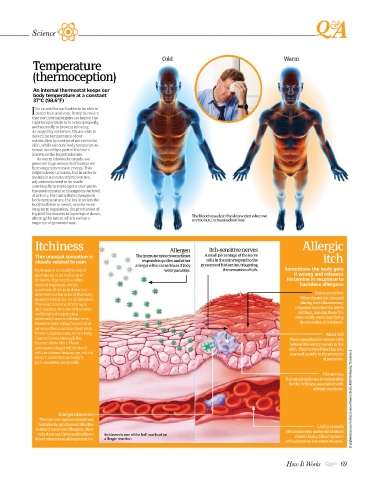
            thyroid hormone is ramped up or down,                   The blood vessels in the skin widen when we
            altering the rate at which we burn                      are too hot, increasing heat loss
            sugars and generate heat.


             Itchiness                                       Allergen     Itch-sensitive nerves            Allergic

             This unusual sensation is           The immune system sometimes   A small percentage of the nerve     itch
             closely related to pain               responds to pollen and other   cells in the skin respond to the
                                                 allergens like cat saliva as if they   presence of histamine, triggering
             Itchiness is the body’s way of                were parasites.     the sensation of itch.  Sometimes the body gets
             alerting us to parasites and                                                               it wrong and releases
             irritants. It prompts a refl ex                                                           histamine in response to
             scratch response, which                                                                      harmless allergens
             scientists think is to draw our
             attention to that area of the body                                                                 Extra sensitive
             so any irritant can be eliminated.                                                            Other chemicals released
             The exact science of itching is                                                               during the inflammatory
             still unclear, but one of the most                                                          response sensitise the nerve
             well studied culprits is a                                                                   endings, making them fire
             molecule known as histamine.                                                                more easily and magnifying
             Parasites like biting insects and                                                            the sensation of itchiness.
             worms often produce chemicals
             known as proteases, which help                                                                         Mast cell
             them to break through the                                                                 These specialised immune cells
             barrier of the skin. These                                                                behave like sentry towers in the
             proteases trigger white blood                                                             skin. Their normal function is to
             cells to release histamine, which                                                         respond rapidly to the presence
             in turn activates our body’s                                                                         of parasites.
             itch-sensitive nerve cells.

                                                                                                                  Histamine
                                                                                                     This small molecule is responsible
                                                                                                       for the itchiness associated with
                                                                                                               allergic reactions. © 3d4Medical.com/Corbis; Science Photo Library; BSIP SA/Alamy; Thinkstock


                      Allergen detection
               The immune system sometimes
               mistakenly produces antibodies
                                                                                                                Leaky vessels
              to attack harmless allergens. Mast                                                      Histamine also makes local blood
              cells then use these antibodies to   Itchiness is one of the hallmarks of an
             detect when more allergens arrive.  allergic reaction                                       vessels leaky, allowing more
                                                                                                     white blood cells to enter the area.

                                                                                                      How It Works        69

