


Page 100 - How It Works - Book Of Amazing Answers To Curious Questions, Volume 05-15
P. 100
What                         colour


         are the planets?


          Discover the science behind the colours in our Solar System
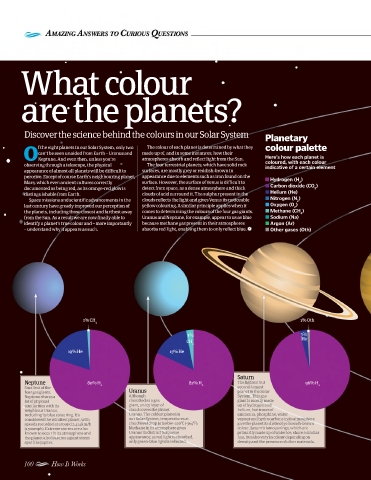
                                                                                              Planetary
              f the eight planets in our Solar System, only two   The colour of each planet is determined by what they   colour palette
              can’t be seen unaided from Earth – Uranus and   made up of, and in some instances, how their
         O Neptune. And even then, unless you’re   atmospheres absorb and reflect light from the Sun.   Here’s how each planet is

                                                                                              coloured, with each colour
          observing through a telescope, the physical   The four terrestrial planets, which have solid rock   indicative of a certain element
          appearance of almost all planets will be diffi cult to   surfaces, are mostly grey or reddish-brown in
          perceive. Except of course Earth’s neighbouring planet,   appearance due to elements such as iron found on the   Q Hydrogen (H )
          Mars, which even ancient cultures correctly   surface. However, the surface of Venus is diffi cult to   2
          documented as being red, as its orange-red glow is   detect from space, as a dense atmosphere and thick   Q Carbon dioxide (CO )
                                                                                                               2
          distinguishable from Earth.              clouds of acid surround it. The sulphur present in the   Q Helium (He)
           Space missions and scientific advancements in the   clouds reflects the light and gives Venus its noticeable   Q Nitrogen (N )


                                                                                                         2
          last century have greatly improved our perception of   yellow colouring. A similar principle applies when it   Q Oxygen (O )
                                                                                                        2
          the planets, including those closest and farthest away   comes to determining the colours of the four gas giants.   Q Methane (CH )
                                                                                                           4

          from the Sun. As a result we are now finally able to   Uranus and Neptune, for example, appear to us as blue   Q Sodium (Na)
          identify a planet’s true colour and – more importantly   because methane gas present in their atmospheres   Q Argon (Ar)
          – understand why it appears as such.     absorbs red light, enabling them to only refl ect blue.     Q Other gases (Oth)


                              1% CH                                                                        1% Oth
                                   4
                                                                   3%                                      3%
                                                                                                           He
                                                                   CH
                                                                     4
                         19% He                              15% He


                                                                                    Saturn
          Neptune               80% H                              82% H            The lightest but        96% H
          Smallest of the           2                                   2           second-largest               2
          four gas giants,                    Uranus                                planet in the Solar
          Neptune shares a                    Although                              System. This gas

          lot of physical                     classified as a gas                    giant is mostly made
          similarities with its               giant, an icy layer of                up of hydrogen and
          neighbour Uranus,                   cloud covers the planet               helium, but traces of
          including its blue colouring. It’s   Uranus. The coldest planet in        ammonia, phosphine, water
          considered the windiest planet, with   our Solar System, temperatures at   vapour and hydrocarbons in its atmosphere
          speeds recorded at around 2,414km/h   cloud level drop to below -220°C (-364°F).   give the planet its distinct yellowish-brown
          (1,500mph). Extreme storms are also   Methane in its atmosphere gives     colour. Saturn’s famous rings, which are
          known to occur in its atmosphere and   Uranus its distinct turquoise      primarily made up of water ice, share a similar
          the planet also features a giant storm   appearance; as red light is absorbed,   hue, but also vary in colour depending on
          spot like Jupiter.                  only green-blue light is refl ected.   density and the presence of other materials.

          100
          100         How It Works
                    How It W


                            orks

