


Page 156 - (DK Eyewitness) Travel Guide - Italian Riviera
P. 156
154 THE IT ALIAN RIVIER A AREA B Y AREA
Exploring Albenga
In the old heart of Albenga, with its superb collection of
medieval piazzas, palazzi and churches, the streets are set
at intersecting right angles, reflecting the grid layout of the
castrum (or military camp) of the early Roman town. With
its plethora of red-brick tower-houses – some still standing
proud, some now much reduced, and many now restored –
the historic centre of Albenga is utterly delightful. This rare
example of a medieval city built on Roman foundations is
undoubtedly one of the top places to visit in the whole of
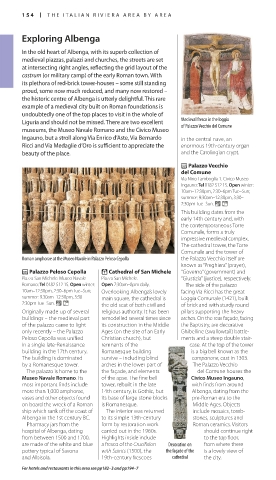
Liguria and should not be missed. There are two excellent Medieval fresco in the loggia
of Palazzo Vecchio del Comune
museums, the Museo Navale Romano and the Civico Museo
Ingauno, but a stroll along Via Enrico d’Aste, Via Bernardo in the central nave, an
Ricci and Via Medaglie d’Oro is sufficient to appreciate the enormous 19th-century organ
beauty of the place. and the Carolingian crypt.
P Palazzo Vecchio
del Comune
Via Nino Lamboglia 1. Civico Museo
Ingauno: Tel 0182 512 15. Open winter:
10am–12:30pm, 2:30–6pm Tue–Sun;
summer: 9:30am–12:30pm, 3:30–
7:30pm Tue–Sun. & =
This building dates from the
early 14th century and, with
the contemporaneous Torre
Comunale, forms a truly
impressive medieval complex.
The cathedral tower, the Torre
Comunale and the tower of
Roman amphorae at the Museo Navale in Palazzo Peloso Cepolla the Palazzo Vecchio itself are
known as “Preghiera” (prayer),
P Palazzo Peloso Cepolla R Cathedral of San Michele “Governo” (government) and
Piazza San Michele. Museo Navale Piazza San Michele. “Giustizia” (justice), respectively.
Romano: Tel 0182 512 15. Open winter: Open 7:30am–8pm daily. The side of the palazzo
10am–12:30pm, 2:30–6pm Tue–Sun; Overlooking Albenga’s lovely facing Via Ricci has the great
summer: 9.30am–12:30pm, 3:30– main square, the cathedral is Loggia Comunale (1421), built
7:30pm Tue–Sun. & = the old seat of both civil and of brick and with sturdy round
Originally made up of several religious authority. It has been pillars supporting the heavy
buildings – the medieval part remodelled several times since arches. On the rear façade, facing
of the palazzo came to light its construction in the Middle the Baptistry, are decorative
only recently – the Palazzo Ages (on the site of an Early Ghibelline (swallowtail) battle-
Peloso Cepolla was unified Christian church), but ments and a steep double stair-
in a single late-Renaissance remnants of the case. At the top of the tower
build ing in the 17th century. Romanesque building is a big bell known as the
The building is dominated survive – including blind campanone, cast in 1303.
by a Romanesque tower. arches in the lower part of The Palazzo Vecchio
The palazzo is home to the the façade, and elements del Comune houses the
Museo Navale Romano. Its of the apse. The fine bell Civico Museo Ingauno,
most important finds include tower, rebuilt in the late with finds from around
more than 1,000 amphorae, 14th century, is Gothic, but Albenga, dating from the
vases and other objects found its base of large stone blocks pre-Roman era to the
on board the wreck of a Roman is Romanesque. Middle Ages. Objects
ship which sank off the coast of The interior was returned include mosaics, tomb-
Albenga in the 1st century BC. to its simple 13th-century stones, sculptures and
Pharmacy jars from the form by restoration work Roman ceramics. Visitors
hospital of Albenga, dating carried out in the 1960s. should continue right
from between 1500 and 1700, High lights inside include to the top floor,
are made of the white and blue a fresco of the Crucifixion Decoration on from where there
pottery typical of Savona with Saints (1500), the the façade of the is a lovely view of
and Albisola. 19th-century frescoes cathedral the city.
For hotels and restaurants in this area see pp182–3 and pp194–7
154-155_EW_Italian_Riviera.indd 154 09/09/16 10:48 am

