


Page 159 - (DK Eyewitness) Travel Guide - Italian Riviera
P. 159
THE RIVIER A DI PONENTE 157
fortified complex must have The latter contains a St John the
been impressive in its heyday. Baptist, a 17th-century work in
Through the castle gate is the multicoloured wood by Poggio,
church of Santi Giacomo e and an 18th-century Crucifixion
Filippo, founded in 1100 and attributed to Maragliano.
once part of the castle’s defences. Also in the town there are
Built entirely out of stone from several interesting 17th- and 18th-
nearby Capo Mele, the façade is century palazzi. These include
adorned with Gothic cornices Palazzo Morchio, now the town
and arches. Inside, there are hall, and Palazzo Viale, which
round columns and octagonal has 18th-century porticoes.
pilasters of bare stone.
Another church within the E Museo Etnografico del
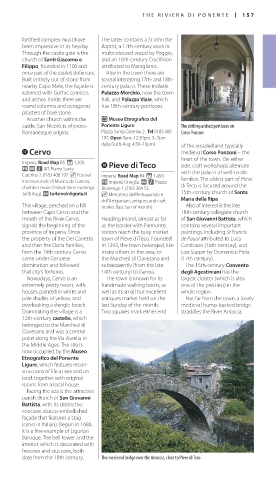
castle, San Nicolò, is of proto- Ponente Ligure The striking arched porticoes on
Romanesque origins. Piazza Santa Caterina 2. Tel 0183 408 Corso Ponzoni
197. Open 9am–12:30pm, 3–7pm
daily (Jul & Aug: 4:30–10pm). of the arcaded and typically
u Cervo medieval Corso Ponzoni – the
heart of the town. On either
Imperia. Road Map B5. * 1,300. i Pieve di Teco
V @ n IAT, Piazza Santa side, craft workshops alternate
Caterina 2, 0183 408 197. _ Festival Imperia. Road Map B4. * 1,450. with the palazzi of well-to-do
Internazionale di Musica da Camera, V Imperia Oneglia. @ n Piazza families. The oldest part of Pieve
chamber music festival (nine evenings Brunengo 1, 0183 364 53. di Teco is focused around the
Jul & Aug). ∑ turismoinliguria.it _ Mercatino dell’Antiquariato e 15th-century church of Santa
dell’Artigianato, antiques and craft Maria della Ripa.
This village, perched on a hill market (last Sun of month). Also of interest is the late
between Capo Cervo and the 18th-century collegiate church
mouth of the River Cervo, Heading inland, almost as far of San Giovanni Battista, which
signals the beginning of the as the border with Piemonte, contains several impor tant
province of Imperia. Once visitors reach the busy market paintings, including St Francis
the property of the Del Carretto town of Pieve di Teco. Founded de Pauul attributed to Luca
and then the Doria families, in 1293, the town belonged, like Cambiaso (16th century), and
from the 14th century Cervo many others in the area, to Last Supper by Domenico Piola
came under Genoese the Marchesi di Clavesana and (17th century).
domination and followed subsequently (from the late The 15th-century Convento
that city’s fortunes. 14th century) to Genoa. degli Agostiniani has the
Nowadays, Cervo is an The town is known for its largest cloister (which is also
extremely pretty resort, with handmade walking boots, as one of the prettiest) in the
houses painted in white and well as its small but excellent whole region.
pale shades of yellow, and antiques market held on the Not far from the town, a lovely
overlooking a shingle beach. last Sunday of the month. medieval hump-backed bridge
Dominating the village is a Two squares mark either end straddles the River Arroscia.
12th-century castello, which
belonged to the Marchesi di
Clavesana and was a control
point along the Via Aurelia in
the Middle Ages. The site is
now occupied by the Museo
Etnografico del Ponente
Ligure, which features recon-
structions of life at sea and on
land, together with original
rooms from a local house.
Facing the sea is the attractive
parish church of San Giovanni
Battista, with its distinctive
concave, stucco-embellished
façade that features a stag
(cervo in Italian). Begun in 1686,
it is a fine example of Ligurian
Baroque. The bell tower and the
interior, which is decorated with
frescoes and stuccoes, both
date from the 18th century. The medieval bridge over the Arroscia, close to Pieve di Teco
156-157_EW_Italian_Riviera.indd 157 09/09/16 10:48 am

