


Page 157 - (DK Eyewitness) Travel Guide - Italian Riviera
P. 157
ALBENGA 155
R Baptistry Isola Gallinara
Piazza San Michele. Open combined
ticket with the Museo Ingauno. Riserva Naturale Regionale dell’Isola Gallinara. Tel 0182 541 351 (comune di
Albenga’s most important Albenga). ∑ parks.it
monument is also the only
remaining evidence of the Early This island lies just off the coast between Albenga and Alassio.
Christian era in the whole of Its name derives from the hundreds of wild hens (galline) that
Liguria. It is thought to have used to be resident here. It was also once inhabited by hermit
been founded by Constantius, monks: St Martin of Tours found refuge here in the 4th century
general to the emperor Honorius, and Benedictine monks later founded an abbey, which was
in the 5th century. Restoration destroyed in the late 15th century – its ruins are still visible. At the
work completed in the 20th top of the island stands the Torre di Vedetta, a tower built by the
century returned the building Republic of Genoa in the 16th century. Isola Gallinara is now a
to its original appearance. nature reserve and cannot be visited. Boat trips (including those
Unusually, the Baptistry for diving) leave from Alassio.
takes the form of an irregular
decagon outside, and a regular
octagon inside. There is a niche
in each of these eight sides,
with columns of Corsican
granite topped by Corinthian
capitals supporting the arches
above. The entrance to the
Baptistry is through one of
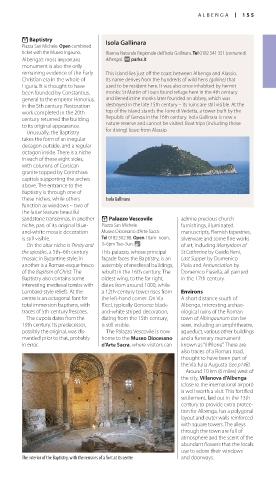
these niches, while others Isola Gallinara
function as windows – two of
the latter feature beautiful
sandstone transennas. In another R Palazzo Vescovile admire precious church
niche, part of its original blue- Piazza San Michele. furnish ings, illuminated
and-white mosaic decoration Museo Diocesano d’Arte Sacra: manuscripts, Flemish tapestries,
is still visible. Tel 0182 502 88. Open 10am–noon, silverware and some fine works
On the altar niche is Trinity and 3–6pm Tue–Sun. & of art, including Martyrdom of
the apostles, a 5th–6th century This palazzo, whose principal St Catherine by Guido Reni,
mosaic in Byzantine style; in façade faces the Baptistry, is an Last Supper by Domenico
another is a Roman-esque fresco assembly of medieval buildings, Piola and Annunciation by
of the Baptism of Christ. The rebuilt in the 16th century. The Domenico Fiasella, all painted
Baptistry also contains some oldest wing, to the far right, in the 17th century.
interesting medieval tombs with dates from around 1000, while
Lombard-style reliefs. At the a 12th-century tower rises from Environs
centre is an octagonal font for the left-hand corner. On Via A short distance south of
total immersion baptisms, with Ricci, typically Genoese black- Albenga, interesting archae-
traces of 5th-century frescoes. and-white striped decoration, ological ruins of the Roman
The cupola dates from the dating from the 15th century, town of Albingaunum can be
19th century. Its predecessor, is still visible. seen, including an amphitheatre,
possibly the original, was dis- The Palazzo Vescovile is now aqueduct, various other buildings
mantled prior to that, probably home to the Museo Diocesano and a funerary monument
in error. d’Arte Sacra, where visitors can known as “il Pilone”. There are
also traces of a Roman road,
thought to have been part of
the Via Julia Augusta (see p148).
Around 10 km (6 miles) west of
the city, Villanova d’Albenga
(close to the inter national airport)
is well worth a visit. This fortified
settlement, laid out in the 13th
century to provide extra protec-
tion for Albenga, has a polygonal
layout and outer walls reinforced
with square towers. The alleys
through the town are full of
atmosphere and the scent of the
abundant flowers that the locals
use to adorn their windows
The interior of the Baptistry, with the remains of a font at its centre and doorways.
154-155_EW_Italian_Riviera.indd 155 09/09/16 10:48 am

