


Page 125 - Off The Tourist Trail - 1000 Unexpected Travel Alternatives (Part 2 of 2)
P. 125
293
FORGET KYOTO? CITIES
THE BUILD-UP Having served as the imperial
capital of Japan for more than 1,000 years,
Kyoto boasts a suitably impressive collection
of palaces, temples, shrines, and gardens.
Geishas still trip through streets lined with
traditional inns and townhouses.
THE LETDOWN Kyoto was largely spared
from bombing during World War II, but much
of its magnificence has been destroyed by
factories, traffic, and high-rise apartment blocks.
City planning has occasionally bordered on
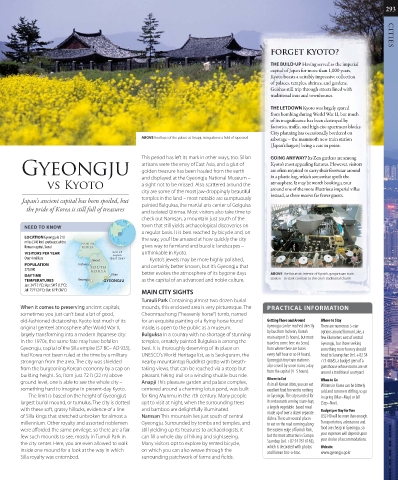
ABOVE Rooftops of the palace at Anapji, rising above a field of rapeseed sabotage – the mammoth new train station
(Japan’s largest) being a case in point.
Gyeongju This period has left its mark in other ways, too. Sillan GOING ANYWAY? Its Zen gardens are among
artisans were the envy of East Asia, and a glut of
Kyoto’s most appealing features. However, visitors
are often required to carry their footwear around
golden treasure has been hauled from the earth
vs Kyoto and displayed at the Gyeongju National Museum – in a plastic bag, which somewhat spoils the
atmosphere. It may be worth booking a tour
a sight not to be missed. Also scattered around the
city are some of the most jaw-droppingly beautiful around one of the more illustrious imperial villas
instead, as these receive far fewer guests.
Japan’s ancient capital has been spoiled, but temples in the land – most notable are sumptuously
painted Bulguksa, the martial arts center of Golgulsa
the pride of Korea is still full of treasures
and isolated Girimsa. Most visitors also take time to
check out Namsan, a mountain just south of the
town that still yields archaeological discoveries on
NEED TO KNOW
a regular basis. It is best reached by bicycle and, on
LOCATION Gyeongju is 210 the way, you’ll be amazed at how quickly the city
miles (340 km) southeast of the
/035)
Korean capital, Seoul ,03&" gives way to farmland and bucolic landscapes –
VISITORS PER YEAR 4 FB PG unthinkable in Kyoto.
+BQBO
Over 4 million &BTU 4 FB
4FPVM Kyoto’s jewels may be more highly polished,
POPULATION *ODIFPO and certainly better known, but it’s Gyeongju that
270,000 4065)
,03&"
DAYTIME 6MTBO better evokes the atmosphere of its bygone days ABOVE The futuristic interior of Kyoto’s gargantuan train
station – in stark contrast to the city’s traditional charm
TEMPERATURES ,XBOHKV (:&0/(+6 as the capital of an advanced and noble culture.
Jan: 34°F (1°C); Apr: 54°F (12°C);
Jul: 75°F (24°C); Oct: 61°F (16°C)
MAIN CITY SIGHTS
Tumuli Park Containing almost two dozen burial
When it comes to preserving ancient capitals, mounds, this enclosed area is very picturesque. The PRACTICAL INFORMATION
sometimes you just can’t beat a bit of good, Cheonmachong (“heavenly horse”) tomb, named
old-fashioned dictatorship. Kyoto lost much of its for an exquisite painting of a flying horse found Getting There and Around Where to Stay
original genteel atmosphere after World War II, inside, is open to the public as a museum. Gyeongju can be reached directly There are numerous 5-star
by bus from Incheon, Korea’s options around Bomun Lake, a
largely transforming into a modern Japanese city. Bulguksa In a country with no shortage of stunning
main airport (5 hours), but most few kilometers east of central
In the 1970s, the same fate may have befallen temples, ornately painted Bulguksa is among the travelers come here via Seoul, Gyeongju, but those seeking
Gyeongju, capital of the Silla empire (57 BC– AD 935), best. It is thoroughly deserving of its place on from where there are buses something more homey should
had Korea not been ruled at the time by a military UNESCO’s World Heritage list, as is Seokguram, the every half hour or so (4 hours). head to Sarangchae (tel. +82 54
strongman from the area. The city was shielded nearby mountaintop Buddhist grotto with breath- Gyeongju’s tiny train station is 773 4868), a budget gem of a
also served by seven trains a day guesthouse whose rooms are set
from the burgeoning Korean economy by a cap on taking views, that can be reached via a steep but
from the capital (4–5 hours). around a traditional courtyard.
building height. So, from just 72 ft (22 m) above pleasant hiking trail or a winding shuttle-bus ride.
Where to Eat When to Go
ground level, one is able to see the whole city – Anapji This pleasure garden and palace complex, As in all Korean cities, you can eat Winters in Korea can be bitterly
something hard to imagine in present-day Kyoto. centered around a charming lotus pond, was built excellent food for next to nothing cold and summers stifling, so go
The limit is based on the height of Gyeongju’s for King Munmu in the 7th century. Many people in Gyeongju. The city is noted for in spring (Mar–May) or fall
largest burial mound, or tumulus. The city is dotted opt to visit at night, when the surrounding trees its restaurants serving ssam-bap, (Sep–Nov).
a largely vegetable-based meal
with these soft, grassy hillocks, evidence of a line and bamboo are delightfully illuminated. Budget per Day for Two
made up of over a dozen separate
of Silla kings that stretched unbroken for almost a Namsan This mountain lies just south of central US$140 will be more than enough.
dishes. There are several places
millennium. Other royalty and assorted noblemen Gyeongju. Surrounded by tombs and temples, and to eat on the road running along Transportation, admissions and
were afforded the same privilege, so there are a fair still yielding up its treasures to archaeologists, it the eastern edge of Tumuli Park, food are cheap in Gyeongju, so
your expenses will depend upon
few such mounds to see, mostly in Tumuli Park in can fill a whole day of hiking and sightseeing. but the most attractive is Sampo your choice of accommodations.
Ssambap (tel. +82 54 762 6148),
the city center. Here, you are even allowed to walk Many visitors opt to explore by rented bicycle,
which is decorated with photos Website
inside one mound for a look at the way in which on which you can also weave through the
and Korean bric-a-brac. www.gyeongju.go.kr
Silla royalty was entombed. surrounding patchwork of farms and fields.
US292-293_cit_gyeongju.indd 293 20/3/09 10:51:05
16/4/09 12:34:58
292-293_cit_gyeongju.indd 293

