


Page 20 - (DK Eyewitness) Travel Guide - New Orleans
P. 20
18 INTRODUCING NE W ORLEANS
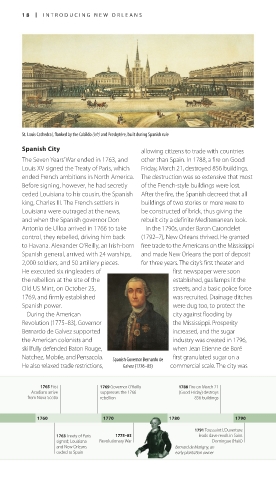
St. Louis Cathedral, flanked by the Cabildo (left) and Presbytère, built during Spanish rule
Spanish City allowing citizens to trade with countries
The Seven Years’ War ended in 1763, and other than Spain. In 1788, a fire on Good
Louis XV signed the Treaty of Paris, which Friday, March 21, destroyed 856 buildings.
ended French ambitions in North America. The destruction was so extensive that most
Before signing, however, he had secretly of the French-style buildings were lost.
ceded Louisiana to his cousin, the Spanish After the fire, the Spanish decreed that all
king, Charles III. The French settlers in buildings of two stories or more were to
Louisiana were outraged at the news, be construc ted of brick, thus giving the
and when the Spanish governor Don rebuilt city a definite Mediterranean look.
Antonio de Ulloa arrived in 1766 to take In the 1790s, under Baron Carondelet
control, they rebelled, driving him back (1792–7), New Orleans thrived. He granted
to Havana. Alexander O’Reilly, an Irish-born free trade to the Americans on the Mississippi
Spanish general, arrived with 24 warships, and made New Orleans the port of deposit
2,000 soldiers, and 50 artillery pieces. for three years. The city’s first theater and
He executed six ringleaders of first newspaper were soon
the rebellion at the site of the established, gas lamps lit the
Old US Mint, on October 25, streets, and a basic police force
1769, and firmly established was recruited. Drainage ditches
Spanish power. were dug too, to protect the
During the American city against flooding by
Revolution (1775–83), Governor the Mississippi. Prosperity
Bernardo de Galvez supported increased, and the sugar
the American colonists and industry was created in 1796,
skillfully defended Baton Rouge, when Jean Etienne de Boré
Natchez, Mobile, and Pensacola. Spanish Governor Bernardo de first granulated sugar on a
He also relaxed trade res trictions, Galvez (1776–85) commercial scale. The city was
1765 First 1769 Governor O’Reilly 1788 Fire on March 21
Acadians arrive suppresses the 1766 (Good Friday) destroys
from Nova Scotia rebellion 856 buildings
1760 1770 1780 1790
1791 Toussaint L’Ouverture
1763 Treaty of Paris 1775–83 leads slave revolt in Saint
signed; Louisiana Revolutionary War Domingue (Haiti)
and New Orleans Bernard de Marigny, an
ceded to Spain early plantation owner
018-019_EW_New_Orl.indd 18 05/08/16 3:48 pm
Eyewitness Travel LAYERS PRINTED:
History Portrait template “UK” LAYER
(Source v1.2)
Date 20th August 2012
Size 125mm x 217mm

