


Page 22 - (DK Eyewitness) Travel Guide - New Orleans
P. 22
20 INTRODUCING NE W ORLEANS
Steamboats, Cotton,
and Sugar
The arrival of the first steamboat,
in 1812, opened the city’s trade
to the interior and the upcountry
plantations. Before the steamboat,
cargo was carried on flatboats,
which floated down the Ohio
and Mississippi from Louisville,
Kentucky, on a journey that
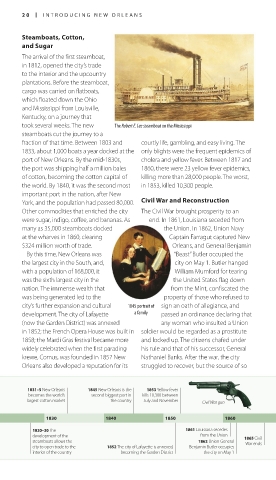
took several weeks. The new The Robert E. Lee steamboat on the Mississippi
steamboats cut the journey to a
fraction of that time. Between 1803 and courtly life, gambling, and easy living. The
1833, about 1,000 boats a year docked at the only blights were the frequent epidemics of
port of New Orleans. By the mid-1830s, cholera and yellow fever. Between 1817 and
the port was shipping half a million bales 1860, there were 23 yellow fever epidemics,
of cotton, becoming the cotton capital of killing more than 28,000 people. The worst,
the world. By 1840, it was the second most in 1853, killed 10,300 people.
important port in the nation, after New
York, and the population had passed 80,000. Civil War and Reconstruction
Other commodities that enriched the city The Civil War brought prosperity to an
were sugar, indigo, coffee, and bananas. As end. In 1861, Louisiana seceded from
many as 35,000 steamboats docked the Union. In 1862, Union Navy
at the wharves in 1860, clearing Captain Farragut captured New
$324 million worth of trade. Orleans, and General Benjamin
By this time, New Orleans was “Beast” Butler occupied the
the largest city in the South, and, city on May 1. Butler hanged
with a population of 168,000, it William Mumford for tearing
was the sixth largest city in the the United States flag down
nation. The immense wealth that from the Mint, confiscated the
was being generated led to the property of those who refused to
city’s further expansion and cultural 1845 portrait of sign an oath of allegiance, and
development. The city of Lafayette a family passed an ordinance declaring that
(now the Garden District) was annexed any woman who insulted a Union
in 1852; the French Opera House was built in soldier would be regarded as a prostitute
1858; the Mardi Gras festival became more and locked up. The citizens chafed under
widely celebrated when the first parading his rule and that of his successor, General
krewe, Comus, was founded in 1857 New Nathaniel Banks. After the war, the city
Orleans also developed a reputation for its struggled to recover, but the source of so
1831–5 New Orleans 1845 New Orleans is the 1853 Yellow fever 1866
becomes the world’s second biggest port in kills 10,300 between Mechanics
largest cotton market the country July and November Civil War gun Hall Riot
1830 1840 1850 1860
1820–30 The 1861 Louisiana secedes
development of the from the Union 1865 Civil
steamboats allows the 1862 Union General War ends
city to open trade to the 1852 The city of Lafayette is annexed, Benjamin Butler occupies
interior of the country becoming the Garden District the city on May 1
020-021_EW_New_Orl.indd 20 05/08/16 3:48 pm
Eyewitness Travel LAYERS PRINTED:
History Portrait template “UK” LAYER
(Source v1.2)
Date 20th August 2012
Size 125mm x 217mm

