


Page 21 - (DK Eyewitness) Travel Guide - New Orleans
P. 21
THE HIST OR Y OF NE W ORLEANS 19
home to important plantations like
the one owned by Bernard de
Marigny in the Lower French Quarter.
New Orleans also received an infusion
of talented men from the French
colony of Saint Domingue (now
Haiti), who had fled the slave uprising
there in 1791. By 1804, refugee
planters and slaves were pouring into
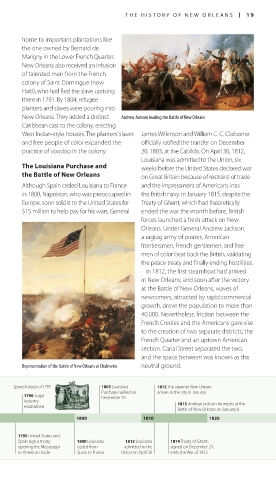
New Orleans. They added a distinct Andrew Jackson leading the Battle of New Orleans
Caribbean cast to the colony, erecting
West Indian-style houses. The planters’ slaves James Wilkinson and William C. C. Claiborne
and free people of color expanded the officially ratified the transfer on December
practice of voodoo in the colony. 20, 1803, at the Cabildo. On April 30, 1812,
Louisiana was admitted to the Union, six
The Louisiana Purchase and weeks before the United States declared war
the Battle of New Orleans on Great Britain because of restraint of trade
Although Spain ceded Louisiana to France and the impressment of Americans into
in 1800, Napoleon, who was preoccupied in the British navy. In January 1815, despite the
Europe, soon sold it to the United States for Treaty of Ghent, which had theoretically
$15 million to help pay for his wars. General ended the war the month before, British
forces launched a fresh attack on New
Orleans. Under General Andrew Jackson,
a ragtag army of pirates, American
frontiersmen, French gentlemen, and free
men of color beat back the British, validating
the peace treaty and finally ending hostilities.
In 1812, the first steamboat had arrived
in New Orleans, and soon after the victory
at the Battle of New Orleans, waves of
newcomers, attracted by rapid commercial
growth, drove the population to more than
40,000. Nevertheless, friction between the
French Creoles and the Americans gave rise
to the creation of two separate districts; the
French Quarter and an uptown American
section. Canal Street separated the two,
and the space between was known as the
Representation of the Battle of New Orleans at Chalmette neutral ground.
Spanish treaty of 1795 1803 Louisiana 1812 The steamer New Orleans
Purchase ratified on arrives in the city in January
1796 Sugar December 20
industry 1815 Andrew Jackson triumphs at the
established
Battle of New Orleans on January 8
1800 1810 1820
1795 United States and
Spain sign a treaty 1800 Louisiana 1812 Louisiana 1814 Treaty of Ghent,
opening the Mississippi ceded from admitted to the signed on December 24,
to American trade Spain to France Union on April 30 ends the War of 1812
018-019_EW_New_Orl.indd 19 05/08/16 3:48 pm

