


Page 23 - (DK Eyewitness) Travel Guide - New Orleans
P. 23
THE HIST OR Y OF NE W ORLEANS 21
much of the city’s wealth – the upriver
plantations – had been destroyed. The “Old
South” never recovered; the steamboat era
was over, and the economic shift toward
the northeast left New Orleans languishing.
Poor race relations troubled the city after
the Civil War. In 1865, at the end of the Civil
War, slaves were freed but lived in legal
limbo. In 1866, a race riot broke out near
Mechanics Hall in downtown New Orleans,
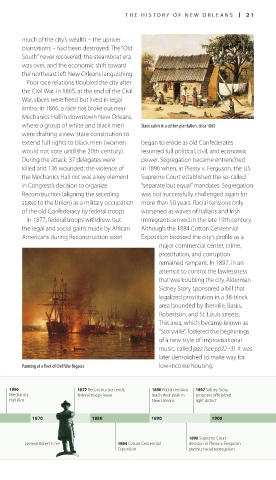
where a group of white and black men Slave cabin in a cotton plantation, circa 1860
were drafting a new state constitution to
extend full rights to black men (women began to erode as old Confederates
would not vote until the 20th century). resumed full political, civil, and economic
During the attack, 37 delegates were power. Segregation became entrenched
killed and 136 wounded; the violence of in 1896 when, in Plessy v. Ferguson, the US
the Mechanics Hall riot was a key element Supreme Court established the so-called
in Congress’s decision to organize “separate but equal” mandates. Segregation
Reconstruction (aligning the seceding was not successfully challenged again for
states to the Union) as a military occupation more than 50 years. Racial tensions only
of the old Confederacy by federal troops. worsened as waves of Italians and Irish
In 1877, federal troops withdrew, but immigrants arrived in the late 19th century.
the legal and social gains made by African Although the 1884 Cotton Centennial
Americans during Reconstruction soon Exposition boosted the city’s profile as a
major commercial center, crime,
prostitution, and corruption
remained rampant. In 1897, in an
attempt to control the lawlessness
that was troubling the city, Alderman
Sidney Story sponsored a bill that
legalized prostitution in a 38-block
area bounded by Iberville, Basin,
Robertson, and St. Louis streets.
This area, which became known as
“Storyville”, fostered the beginnings
of a new style of impro visational
music, called jazz (see pp22–3). It was
later demolished to make way for
Painting of a fleet of Civil War frigates low-income housing.
1866 1877 Reconstruction ends; 1890 Racial tensions 1897 Sidney Story
Mechanics federal troops leave reach their peak in proposes official red
Hall Riot New Orleans light district
1870 1880 1890 1900
1896 Supreme Court
General Robert E. Lee 1884 Cotton Centennial decision in Plessy v. Ferguson
Exposition permits racial segregation
020-021_EW_New_Orl.indd 21 05/08/16 3:48 pm

